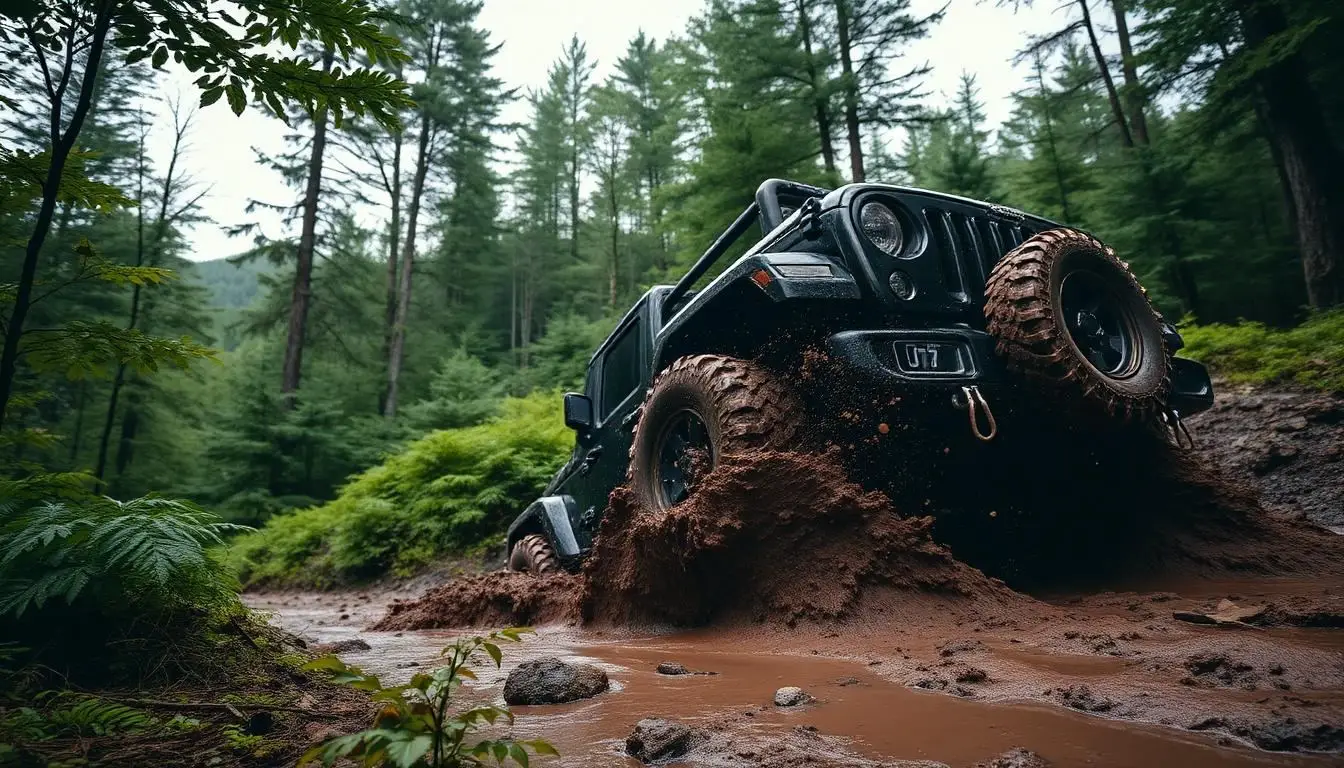
Less open land. More mud. Tighter communities. And trails that will humble you faster than you think. Here's why East Coast off-roading is a completely different animal, and why it belongs on your bucket list.
There's a persistent myth in the off-road world that goes something like this: the West Coast has all the real wheeling, and the East Coast is where people drive Jeeps to brunch.
It's wrong. Confidently, completely, demonstrably wrong.
East Coast off-roading is a different experience from what you'll find in Moab or on the Rubicon. Nobody's pretending otherwise. The terrain is different. The access model is different. The weather adds a variable that most Western wheelers frankly don't have to deal with. But different doesn't mean lesser. The East Coast has produced some of the most passionate, resourceful, and tight-knit off-road communities in the country. It's home to the largest privately owned off-road park in the United States. It has an overlanding route that rivals anything out West for sheer mileage and scenery. And it has mud: the kind of sticky, clay-heavy, axle-deep mud that will make your carefully built rock crawler feel completely helpless.
If you've only ever wheeled out West, the East Coast will recalibrate your expectations. If you've only ever wheeled out East, you probably already know something that the rest of the community is only starting to figure out: these trails are no joke.
Let's get into it.
East Coast vs. West Coast Off-Roading: Understanding the Difference
Before we talk about specific destinations, it's worth addressing the fundamental difference between East Coast and West Coast wheeling, because it shapes everything from how you plan a trip to how you build your rig.
Out West, the model is public land. Bureau of Land Management acreage, national forests, and vast stretches of open desert give Western wheelers nearly unlimited access to terrain. You can drive until you find something interesting, camp wherever you stop, and explore routes that have never been formally mapped. For the full breakdown of what makes that possible, check out our West Coast off-roading guide.
Out East, the model is curated access. The majority of serious off-road destinations on the East Coast fall into two categories: privately owned off-road parks and designated OHV trail systems within national forests. There's far less BLM land. Dispersed camping is more restricted. The available wheeling acreage is more concentrated and, in many cases, requires a fee, a membership, or a permit.
That sounds limiting on paper. In practice, it creates something genuinely valuable: well-maintained trail systems with clear difficulty ratings, on-site support infrastructure, and communities that form around specific parks the way neighborhoods form around good schools. When you wheel Rausch Creek or Windrock regularly, you get to know the trails intimately. You learn the lines. You recognize the regulars. The experience deepens over time in a way that casual open-land wheeling sometimes doesn't.
Note
None of this makes East Coast wheeling better or worse than the West. It makes it different. And for a lot of people, that difference is exactly the appeal.
Windrock Park, Tennessee: The Largest Off-Road Park in America
If the East Coast has a single flagship destination, its answer to Moab, its gravitational center, it's Windrock Park.
Located in Oliver Springs, Tennessee, about 30 miles northwest of Knoxville, Windrock sits on a staggering 73,000 acres of Appalachian mountain terrain. That number is not a typo. This is the largest privately owned off-road recreation area in the United States, and it backs up that claim with over 300 miles of trails that accommodate everything from bone-stock daily drivers to purpose-built competition crawlers.
The trail system is color-coded by difficulty: green for easy, blue for intermediate, black for difficult, and red for the kind of terrain that makes grown adults reconsider their life choices. The green trails are genuine beginner-friendly routes, wide enough for full-size trucks, with obstacles that introduce new wheelers to elevation changes and light rock without punishing mistakes. The black and red trails are a completely different conversation. Trails like Crawler Ridge and Crawl Daddy, both designated Jeep Badge of Honor trails, feature boulder fields, off-camber rock shelves, and sustained technical sections that demand serious builds and serious driving.
Tip
The mud factor at Windrock is real and seasonal. East Tennessee gets substantial rainfall, and the mountain trails hold moisture. After a good rain, even the green trails develop mud holes that will test your ground clearance and your patience. The experienced Windrock regulars will tell you: bring mud-terrain tires, and bring a winch. The mountain doesn't care about your trail rating when it's been raining for three days.
Windrock also hosts multiple off-road events throughout the year: Jeep Jamborees, rock crawling competitions, charity rides, and seasonal gatherings that draw wheelers from across the Southeast and beyond. If you're new to East Coast wheeling and want a single destination that demonstrates the full range of what this side of the country offers, Windrock is where you start.
Rausch Creek Off-Road Park, Pennsylvania: The Northeast's Premier Trail System
If Windrock is the East Coast's answer to Moab, Rausch Creek is its answer to the Hammer Trails, a place where technical rock crawling takes center stage and the community around it is fiercely dedicated.
Located in Pine Grove, Pennsylvania, about 150 miles west of New York City and within a four-hour drive of Philadelphia, Baltimore, Washington D.C., and most of the densely populated Northeast corridor, Rausch Creek occupies a strategic position that makes it accessible to a massive population of potential wheelers. The park spans 3,000 acres of former coal country, and the terrain that mining left behind turns out to be spectacularly well-suited for four-wheeling.
The trail system covers over 80 miles and uses a ski-slope-style difficulty rating: green, blue, purple (blue-black), black, and red. The green trails offer gentle forest roads with light obstacles, perfect for stock 4x4s getting their first taste of dirt. The red trails are a different universe. Crucible, one of the park's newer extreme-rated trails, features boulders large enough to make 40-inch tires look small and obstacles that push even purpose-built crawlers to their limits.
What sets Rausch Creek apart from many East Coast parks is its 4x4-only policy. No ATVs. No UTVs. No dirt bikes. This is a park built specifically for trucks, Jeeps, and SUVs, and that focus shows in the trail design. The obstacles are scaled to full-size vehicles, the bypasses are thoughtfully placed so that groups with mixed build levels can run together, and the community that has formed around the park is deeply invested in the wheeling culture.
There's a two-vehicle minimum at Rausch Creek. You can't run the trails alone. That might sound restrictive, but it reflects a genuine safety-first philosophy and it naturally builds community. If you show up without a trail partner, the park's Facebook group (Rausch Creek Connection) is an active place to find groups looking for additional rigs.
Rausch Creek is open year-round, Thursday through Sunday, with midweek access available by arrangement. The fall foliage season, September through November, is genuinely spectacular here. Pennsylvania's hardwood forests put on a color show that rivals anything in New England, and running trails through tunnels of red, orange, and gold while working through technical rock sections is an experience you simply can't get in the Western desert.
Uwharrie National Forest, North Carolina: Public Land Wheeling Done Right
For East Coast wheelers who want the public-land experience, national forest terrain without the gate fees and membership requirements of private parks, Uwharrie National Forest is the destination.
Located about an hour east of Charlotte, North Carolina, in the heart of the ancient Uwharrie Mountains, this forest provides the only public OHV trail system in the Piedmont region of the state. The mountains here are old, genuinely old, as in 450-million-years-of-volcanic-origin old, and while they've eroded from their former 20,000-foot peaks down to a modest 900 feet or so, the rocky terrain they left behind is steep, technical, and varied enough to keep wheelers coming back weekend after weekend.
The trail system ranges from mellow dirt roads that meander through the forest to legitimately challenging rocky climbs with names like Dutch John, Dickie Bell, and Daniel that have earned reputations among Southeast wheelers. On a dry day, a mildly modified Wrangler can handle most of what Uwharrie throws at you. Add rain to the equation, and the clay surface layer transforms the entire trail system. Moderate trails become genuinely difficult. Difficult trails become recovery situations.
Note
The camping at Uwharrie is excellent. Primitive dispersed camping is permitted in most of the forest unless otherwise posted, and there are developed campgrounds nearby for those who prefer amenities. The combination of accessible public land, genuine technical challenge, and the kind of quiet Appalachian forest beauty that the Southeast does better than almost anywhere makes Uwharrie a standout, and a trail system that West Coast wheelers who visit are consistently surprised by.
Gulches ORV Park, South Carolina: Steep, Rocky, and Underrated
Tucked into 80 acres in Laurens County, South Carolina, Gulches ORV Park doesn't have the acreage of Windrock or the reputation of Rausch Creek. What it does have is some of the steepest, rockiest, most immediately challenging terrain on the East Coast, packed into a format that makes it perfect for a hard day of wheeling.
The park features roughly 40 miles of trails winding through its compact footprint, and the difficulty is front-loaded. The terrain here is steep and rocky in a way that feels closer to West Coast crawling than most East Coast parks. The trails are wider than average for a private park, but don't let that fool you. The obstacles are genuine, the grades are aggressive, and the rock is the kind that tests your skid plates and your nerve simultaneously.
The trail design at Gulches is smart. Difficult sections are networked through easier trails, with bypasses built in so that groups with different build levels can stay together. A stock 4x4 can have a full day of fun on the easier trails while a built crawler takes the hard lines, and they can meet up at the same intersections. It creates a naturally social experience and makes Gulches a great park for mixed-experience groups.
Gulches is open Friday through Sunday and offers weekend passes alongside day passes. Camping is available on-site. The park is easily accessible from both Charlotte and Columbia, making it a realistic day trip or weekend destination for a large chunk of the Southeast wheeling community. If you've been sleeping on Gulches, wake up. It punches well above its weight.
The Smoky Mountain 1000: East Coast Overlanding at Its Best
The West Coast has the Mojave Road. The East Coast has the Smoky Mountain 1000.
The SM1000 is a roughly 1,000-mile adventure loop through the Appalachian Mountains, threading through parts of Tennessee, North Carolina, Georgia, and South Carolina. The route follows a mix of gravel, dirt, and paved forest service roads through the Cherokee and Nantahala National Forests, through the foothills of the Great Smoky Mountains, and across some of the most visually stunning backcountry in the Eastern United States.
Tip
The SM1000 gained significant attention in the overlanding community for good reason. The scenery is world-class: Appalachian ridgelines, mountain streams, hardwood forests that explode with color in autumn, and the kind of quiet, remote backcountry that most people associate with places much farther west. There's also a shorter SM500 variant for those who want the experience in a tighter timeframe. GPX files for both routes are available online and the route is well-documented by the community that runs it.
For East Coast overlanders, or West Coast overlanders looking for something genuinely different, the Smoky Mountain 1000 demonstrates that extended backcountry travel is absolutely not a West-only proposition. The Appalachians have their own kind of wild, and it's worth experiencing.
The Appalachian Mud Factor: What West Coast Wheelers Don't Understand
This section exists because it needs to.
If you've spent your wheeling career on dry Western rock, you have a gap in your skillset. It's not a criticism. It's a fact of geography. Mud changes everything about how you drive, how you build, and how you recover. And on the East Coast, mud is not an occasional inconvenience. It's a defining feature of the terrain.
The soils of the Appalachian region and the Piedmont are heavy in clay. When that clay gets wet, it becomes a substance with almost supernatural properties. It's slick enough to make a locked differential spin all four tires without moving the vehicle an inch. It's adhesive enough to pack into your wheel wells until your tires are smooth circles of mud-caked rubber with zero traction. And it's deep enough, in the worst spots, to swallow a 35-inch tire up to the sidewall and hold it there with genuine malice.
Warning
Tire choice matters enormously in East Coast conditions. The aggressive rock-terrain tires that dominate the West Coast are not always the best choice for Eastern clay mud. A good mud-terrain tire with deep, widely spaced lugs and a self-cleaning tread pattern will outperform a rock tire in wet clay every time. The lugs need space between them so the mud can clear as the tire rotates. Packed lugs are bald tires.
The mud also changes recovery dynamics. A vehicle stuck in mud is a different recovery problem than a vehicle high-centered on a rock. Kinetic energy recovery ropes excel in mud because they use momentum and stretch to pull a stuck vehicle free. Winching works but is slower and harder to anchor. High-lift jacks are nearly useless in soft ground unless you carry a base plate. Know your tools. Know your terrain. And accept that on the East Coast, getting stuck is not a failure. It's a Tuesday.
Green Mountain National Forest, Vermont: Northeast Wheeling's Hidden Gem
The Northeast doesn't get enough credit for off-roading, and Green Mountain National Forest is a big reason why that needs to change.
Spanning over 400,000 acres across the spine of Vermont, the Green Mountain National Forest offers a network of forest roads and designated trails that provide some of the most scenic wheeling in the entire Eastern United States. This is not extreme rock crawling territory. It's backcountry touring through some of the most beautiful mountain forest landscape in North America.
The trails here wind through hardwood forests, past mountain streams, and along ridgelines with views that stretch across the Green Mountains in every direction. In summer, the forest is lush and alive: wildflowers, wildlife, and the kind of deep-green canopy that makes everything feel cooler and quieter. In fall, it becomes one of the most visually spectacular places to drive any vehicle, period. Vermont fall foliage from the seat of a 4x4, on a dirt road that most tourists will never see, is an experience that stays with you.
Dispersed camping is permitted in many areas of the forest, and the combination of accessible trails, genuine backcountry feel, and proximity to charming Vermont towns makes Green Mountain an excellent multi-day destination.
For wheelers in the Boston-to-New York corridor who think they need to drive to Tennessee or Pennsylvania to find real trails, Green Mountain National Forest is a wake-up call. It's right there. Go.
George Washington National Forest, Virginia: The Mid-Atlantic's Best Kept Secret
For wheelers in the D.C.-Baltimore-Richmond metro areas, finding legal off-road access can feel like a scavenger hunt. Virginia's private land dominance means that options are limited and sometimes confusing to navigate. George Washington National Forest is the answer most of those wheelers are looking for.
Spanning over a million acres across the Appalachian Mountains of Virginia and West Virginia, GW National Forest contains designated OHV trail systems that are open to four-wheel-drive vehicles. The terrain is classic Appalachian: forest roads winding through mountain ridges, with rocky sections, creek crossings, and elevation changes that keep things interesting without requiring a fully built crawler.
The trails here range from easy forest service roads suitable for any 4WD to more challenging routes that demand higher clearance and some technical skill. Flagpole Knob near Harrisonburg is a popular destination with panoramic mountain views from the summit. The forest roads throughout the Shenandoah Valley region offer excellent mild-to-moderate wheeling with stunning Blue Ridge scenery.
Tip
East Coast Off-Road Events Worth Planning Around
The East Coast event calendar has matured significantly over the past decade, and several events now draw national-level attendance.
The Great Smoky Mountain Jeep Invasion in Pigeon Forge, Tennessee, has become one of the largest Jeep events in the country. Held in the shadow of the Smokies with easy access to trails like Hurricane Creek, it combines the vendor-show spectacle of a major event with genuine trail access and group runs. For families and newcomers, it's one of the best introductions to the wheeling community available anywhere.
Jeep Jamborees operate at multiple East Coast locations throughout the year, including Rausch Creek and Windrock. These guided group runs are specifically designed to be accessible to stock and lightly modified vehicles, with experienced trail leaders coaching participants through obstacles. If you've never been off-road and you're nervous about your first time, a Jamboree is the safest, most supportive way to start.
The Bantam Jeep Heritage Festival in Butler, Pennsylvania, the birthplace of the original Jeep, draws tens of thousands of Jeep enthusiasts annually for a celebration of the vehicle's history and culture. It's less about trail running and more about the community and heritage, but it's a pillar of the East Coast Jeep scene.
Regional rock crawling competitions and charity rides happen throughout the year at parks like Rausch Creek, Gulches, and Windrock. These events are excellent for spectators and participants alike. Watching experienced drivers work through extreme obstacles is both educational and deeply entertaining.
How to Start Off-Roading on the East Coast: A Beginner's Guide
The barrier to entry on the East Coast is, in some ways, lower than out West, and in other ways, it requires a bit more homework.
Pick a park, not a random trail. The private park model that dominates East Coast wheeling is actually a significant advantage for beginners. Parks like Windrock and Rausch Creek have clearly rated trail systems, on-site staff, and communities of regulars who are generally happy to help newcomers. You don't need to figure out land access, decipher BLM maps, or worry about whether you're on legal ground. Pay your entry fee, grab a trail map, and start on the green trails.
Get your tire game right early. East Coast terrain demands different rubber than the West. If you're running the stock highway tires that came on your 4Runner or Wrangler, you'll be fine on dry green trails. The moment it rains, you'll wish you'd upgraded. A quality all-terrain tire is the minimum for regular East Coast wheeling. If you're heading to parks where mud is a factor, which is most of them most of the time, a mud-terrain tire is a worthwhile investment.
Carry a winch or run with someone who has one. This is more critical on the East Coast than the West, specifically because of mud. On dry rock, getting stuck usually means you're high-centered and need a lift. In mud, getting stuck means you need pulling force, and a lot of it. A winch mounted to your front bumper will save your day, your weekend, and potentially your marriage. Even a basic synthetic-rope winch rated for your vehicle weight is transformative.
Check trail conditions before every trip. East Coast trail conditions are weather-dependent in a way that Western trails simply aren't. A trail that was perfect on Wednesday can be impassable by Saturday after two days of rain. Most parks post condition updates on their websites or social media. Spend five minutes checking before you leave the house.
Join a local club. The East Coast off-road club scene is exceptionally strong, partly because the access model rewards organized groups. Clubs negotiate group rates at parks, organize regular runs, share trail knowledge, and provide the kind of built-in buddy system that makes wheeling safer and more fun.
The East Coast Off-Road Community: Tighter, Closer, and Growing Fast
There's a character to the East Coast off-road community that's distinct from the West, and it's worth calling out.
Because the access is more concentrated, fewer places to go, more people going to the same places, the communities that form around East Coast parks tend to be tighter and more interconnected. The regulars at Rausch Creek know each other. The Windrock weekenders have standing groups. The Uwharrie crowd has its own culture and its own heroes. These aren't anonymous experiences on vast open land. They're recurring gatherings of people who share specific trails, specific obstacles, and specific stories.
That concentration also breeds a particular kind of resourcefulness. East Coast wheelers have historically had to work harder to find legal places to wheel, to navigate access restrictions, and to justify the cost of entry fees and memberships. The result is a community that doesn't take access for granted, that advocates hard for trail preservation, and that tends to police its own behavior on the trails because everyone understands that losing access to a park means losing something that can't be easily replaced.
The growth of East Coast off-roading over the past decade has been significant. Events that drew hundreds now draw thousands. Parks that struggled for attendance are now booking up on peak weekends. The overlanding movement has brought a new wave of enthusiasts to the East Coast backcountry, and the infrastructure, parks, guided services, events, and online communities, has grown to meet them.
The East Coast scene is no longer the little brother of Western wheeling. It's its own thing, with its own strengths, its own challenges, and its own deeply committed community. If you haven't explored it, you're missing out on a dimension of the hobby that the West simply can't replicate.
The Bottom Line: East Coast Off-Roading Deserves a Spot on Your List
The American West gets the magazine covers. It gets the social media attention. It gets the reputation as the place where "real" off-roading happens.
And look, the West has earned that reputation. The terrain is extraordinary. The access is unmatched. If you haven't wheeled Moab or the Rubicon, you absolutely should. Start with our West Coast off-roading guide.
But if that's all you do, you're only seeing half the picture.
The East Coast offers something the West doesn't: the challenge of weather-dependent terrain that forces you to adapt in real time. The camaraderie of tight-knit park communities where people know your rig and remember your last run. The beauty of Appalachian forests that make Western desert look like another planet, not better or worse, just profoundly different. And the satisfaction of wheeling terrain that most of the off-road world has been underestimating for decades.
Windrock. Rausch Creek. Uwharrie. The Smoky Mountain 1000. Gulches. Green Mountain. George Washington National Forest. The destinations are there. The trails are real. The community is thriving.
Go East. Get muddy. You'll come back different.
Note