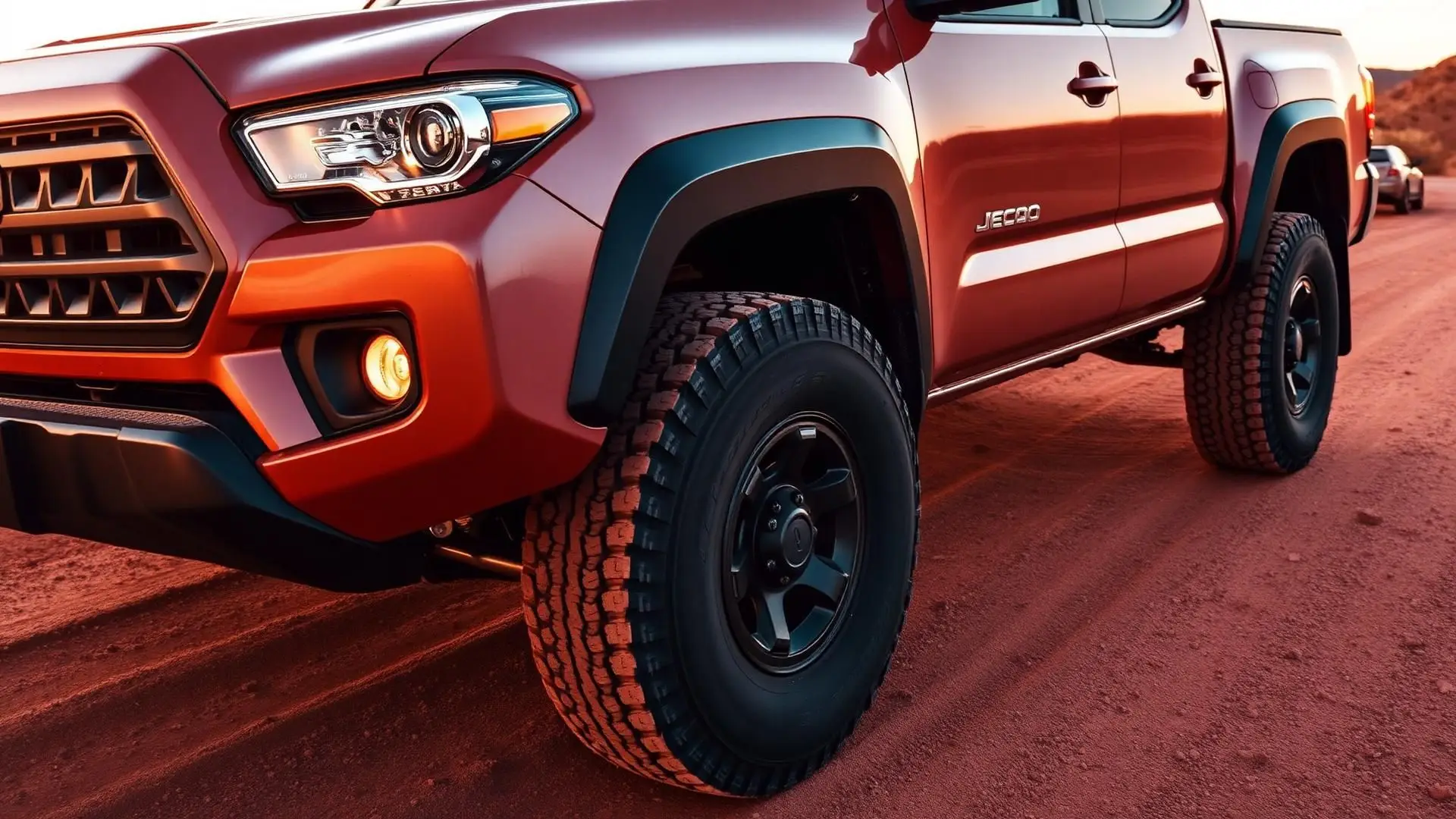
The most common tire question in the Tacoma community is not "what brand should I buy?" It is "what size can I actually fit?" And the frustrating truth is that the answer changes completely depending on which generation you own, which trim you have, and whether you are willing to remove a mud flap or not.
This guide gives you the actual numbers, organized by generation, with honest rub thresholds, wheel offset explanations, and the speedometer math nobody talks about until after you have already bolted on your new tires.
| Generation | Years | Biggest Tire, No Lift | Diameter |
|---|---|---|---|
| Gen 1 | 1995-2004 | 265/75R16 | 31.6" |
| Gen 2 | 2005-2015 | 265/75R16 | 31.6" |
| Gen 3 | 2016-2023 | 265/70R17 | 31.6" |
| Gen 4 (incl. 2026) | 2024-2026 | 285/70R17 | 33.0" |
The short version: Gen 1-3 top out at roughly 31.6 inches on stock suspension; Gen 4 17-inch trims fit a 33. Full breakdown by trim below.
Toyota Tacoma Stock Tire Size by Year
Search your model year below. These are the factory sizes from Toyota's own product information sheets for each year, not forum guesses. Diameter is calculated from the size, so a tire Toyota markets as a "33" can measure a little under 33 inches on paper.
| Model years | Trim or configuration | Stock tire size | Diameter (calculated) |
|---|---|---|---|
| 2013 to 2015 | 4x2 Regular, Access and Double Cab (base) | P215/70R15 | 26.9 in |
| 2013 to 2015 | PreRunner and 4x4 | P245/75R16 | 30.5 in |
| 2013 to 2015 | TRD Off-Road package | P265/70R16 | 30.6 in |
| 2013 to 2015 | TRD Sport package (V6) | P265/65R17 | 30.6 in |
| 2013 to 2015 | Limited package (V6 Double Cab) | P265/60R18 | 30.5 in |
| 2013 | X-Runner | 255/45R18 | 27.0 in |
| 2015 | TRD Pro | P265/70R16 | 30.6 in |
| 2016 to 2023 | SR and SR5 | P245/75R16 | 30.5 in |
| 2016 to 2023 | TRD Sport | P265/65R17 | 30.6 in |
| 2016 to 2023 | TRD Off-Road | P265/70R16 | 30.6 in |
| 2016 to 2023 | Limited | P265/60R18 | 30.5 in |
| 2017 to 2023 | TRD Pro | P265/70R16 all-terrain | 30.6 in |
| 2023 | Trail Special Edition | P265/70R16 all-terrain | 30.6 in |
| 2024 to 2026 | SR and SR5 | 245/70R17 | 30.5 in |
| 2024 to 2026 | SR5 with optional 18-inch wheels | 265/65R18 | 31.6 in |
| 2024 to 2026 | TRD PreRunner and TRD Off-Road (i-FORCE) | 265/70R17 all-terrain | 31.6 in |
| 2024 to 2026 | TRD Sport and Limited | 265/65R18 | 31.6 in |
| 2024 to 2026 | TRD Off-Road (i-FORCE MAX hybrid) | 265/70R18 all-terrain | 32.6 in |
| 2024 to 2026 | TRD Pro and Trailhunter | 265/70R18 (Toyota calls it a 33-inch Goodyear Territory R/T) | 32.6 in |
Your truck's exact size is printed on the tire placard on the driver's door jamb. If the placard and this table disagree, trust the placard, because a previous owner may have changed packages or wheels.
Sources: Toyota pressroom Tacoma product information for each model year (pressroom.toyota.com).
Short Answer: Best Tire Size by Generation (2026 Update)
If you want the number and nothing else: on a stock Tacoma, the best all-around tire size is 265/75R16 or 265/70R17 (roughly 31.6 inches) for Gen 1 through Gen 3, and 285/70R17 (33 inches) on 17-inch Gen 4 trims, including 2026 models. Those sizes clear without a lift, keep speedometer error under 5 percent, and do not require trimming beyond removing the front mud flaps.
How to Read a Tire Size (Quick Reference)
Before the generation breakdown, a fast decoder for anyone who learned this once and forgot it.
A tire labeled 265/70R17 breaks down like this: 265 is the section width in millimeters, 70 is the aspect ratio (the sidewall height as a percentage of the width), R means radial construction, and 17 is the wheel diameter in inches. The overall diameter in inches is roughly calculated as: (sidewall height x 2 / 25.4) + wheel diameter.
For 265/70R17: (265 x 0.70 x 2 / 25.4) + 17 = 31.6 inches overall diameter. Or skip the math and run any two sizes through our tire diameter calculator.
That overall diameter number is what actually matters for clearance, speedometer accuracy, and gearing. The width matters for rubbing on the inner fender. Both numbers matter. Most people only watch one of them.
Gen 1 Tacoma (1995-2004): Best Tire Size
Stock Tire Sizes
First generation Tacomas came with a wide range of sizes depending on drivetrain and trim. The 2WD base models left the factory on 14-inch wheels with tires in the 195/75R14 to 215/70R14 range. The 4WD models stepped up to 15-inch wheels with 225/75R15 as the most common OEM size. The TRD and SR5 4WD trims often came with 265/70R16, and the factory 31x10.5R15 fitment on some 4WD models was one of the few instances of Toyota using flotation sizing from the factory.
The bolt pattern across all 1st gen Tacomas is 6x139.7mm. This matters when swapping wheels.
Biggest Tire on Stock 1st Gen Suspension
For trucks that came on 15-inch wheels, the largest tire that fits cleanly without a lift is 265/75R15 (30.6 inches). On trucks that came on 16-inch wheels, 265/75R16 (31.6 inches) goes in without drama. If you want to step to 33s (285/75R16 or 33x12.5R15), you will need at minimum a body lift or a modest suspension lift.
The 1st gen wheel arch has more room than the later generations, and the short, narrow factory tire width means even a 265 feels like a significant visual upgrade. These trucks also had less inner fender complexity than the later gens, which makes fitting a wider tire somewhat more forgiving.
Gen 2 Tacoma (2005-2015): Best Tire Size
Stock Tire Sizes by Trim
| Trim | Wheel Size | Stock Tire Size | Overall Diameter |
|---|---|---|---|
| 2013 to 2015 4x2 base | 15-inch | P215/70R15 | 26.9 in |
| 2013 to 2015 PreRunner and 4x4 | 16-inch | P245/75R16 | 30.5 in |
| 2013 to 2015 TRD Off-Road package | 16-inch | P265/70R16 | 30.6 in |
| 2013 to 2015 TRD Sport package | 17-inch | P265/65R17 | 30.6 in |
| 2013 to 2015 Limited package | 18-inch | P265/60R18 | 30.5 in |
Biggest Tire on Stock 2nd Gen Suspension
The 265/75R16 (31.6 inches) is the largest tire that fits a stock 2nd gen Tacoma without rubbing, assuming you remove the front mud flaps. This is the most popular upgrade on the platform and has been confirmed clean by thousands of forum builds. The tire fills the wheel well significantly better than the stock 265/70 and gives you a meaningful improvement in ground clearance and traction.
If you are on stock 17-inch wheels, 265/70R17 (31.6 inches) is the equivalent clean fitment.
The 285/75R16 (33 inches) will rub on the cab mount, the upper control arm at full steering lock, and the inner fender liner. To run 33s on a 2nd gen, you need at minimum a 2-3 inch suspension lift. The 2nd gen also has a specific problem called the cab mount rub, which is a metal body mount that sits in the path of the tire arc at full lock. Many 2nd gen owners who run 33s perform a "cab mount chop" where that bracket is trimmed and a flat plate is welded in. It is not required with a proper lift and the right wheel offset, but it comes up constantly in the forums and you should know it exists before you commit to a 33-inch tire on this platform.
Gen 3 Tacoma (2016-2023): Best Tire Size
This is the generation with the most active community research, the most forum data, and the most tire upgrade questions. The 3rd gen ran from 2016 through 2023 and is still one of the most common Tacomas on the road.
Stock Tire Sizes by Trim
| Trim | Wheel Size | Stock Tire Size | Overall Diameter |
|---|---|---|---|
| SR / SR5 | 16-inch | P245/75R16 | 30.5 in |
| TRD Sport | 17-inch | P265/65R17 | 30.6 in |
| TRD Off-Road | 16" | 265/70R16 | 30.6" |
| TRD Pro | 16" | 265/70R16 | 30.6" |
| Limited | 18" | 265/60R18 | 30.5" |
The TRD Pro's dramatically lower wheel offset (+4mm versus the Off-Road's +25mm) is one of the reasons TRD Pro trucks have a wider stance and look more aggressive sitting next to an Off-Road trim on identical tires. It also gives the TRD Pro slightly more inner fender clearance, which is why some tire upgrades that rub on the Off-Road trim fit cleanly on the Pro.
Biggest Tire on Stock 3rd Gen Suspension
This is where most of the community debate lives, so here are the honest tiers:
Zero rub, zero drama: 265/75R16 or 265/70R17 (both ~31.6 inches). These fit every 3rd gen trim on stock suspension, stock wheels, and stock offset. Remove the mud flaps and you are done. This is the upgrade that changes the look and capability of your truck without touching a single suspension component. For trim-by-trim detail, see our guide to 33s on a Tacoma with no lift.
Usually fine, occasional contact: 275/70R17 (32.2 inches). Most 3rd gen owners running this size on stock suspension report clean fitment. Some see minor contact on the inner fender liner at full steering lock, especially with the suspension compressed. Trimming the mud flap tab and rolling the inner fender liner edge is often enough to clear this.
Will rub without modification: 285/70R17 (33.0 inches). This is the magic number for the 3rd gen build community and also the number that requires work. On stock suspension with stock offset wheels, a 285/70R17 will contact the fender liner and cab mount at full lock and under compression. To run 33s cleanly on a stock 3rd gen, you need either a 2-3 inch lift with a leveling kit or full suspension lift, plus a wheel with lower offset (around +15mm to 0mm on 17" wheels), plus fender liner trimming. Some owners get away with 285s on 2-inch leveling kits with offset wheels and careful liner work. None of them will tell you it was friction-free.
Wheel Offset and Why It Matters on the 3rd Gen
Offset is the distance between the center of the wheel and the mounting face. A higher positive offset pushes the wheel inward toward the suspension. A lower offset (or negative offset) pushes the wheel outward, giving you a wider stance and more inner fender clearance.
If you want to run 33s on a 3rd gen without a lift, offset is your best tool. Dropping from the stock +25mm to +0mm or -12mm on a 17-inch wheel pushes the tire outward and away from the inner fender, often enough to eliminate the contact that would otherwise require trimming. The tradeoff is increased stress on wheel bearings, which is why going further than -25mm is not recommended for daily drivers or heavy loads.
The practical sweet spot for 3rd gen owners running 33s with a 2-inch lift is a 17x9 wheel at 0mm to +15mm offset. At that combination, 285/70R17 clears cleanly on most trims.
Gen 4 Tacoma (2024-2026): Best Tire Size
The 4th gen Tacoma launched in 2024 as a ground-up redesign. It rides on a new platform with revised suspension geometry, different fender clearances than the 3rd gen, and comes standard with larger tires on more trims.
Stock Tire Sizes by Trim
| Trim | Wheel Size | Stock Tire Size | Overall Diameter |
|---|---|---|---|
| SR / SR5 | 17-inch | 245/70R17 | 30.5 in |
| TRD PreRunner | 17-inch | 265/70R17 | 31.6 in |
| TRD Sport | 18" | 265/65R18 | 31.6" |
| TRD Off-Road (iForce) | 17" | 265/70R17 | 31.6" |
| TRD Off-Road (iForce Max hybrid) | 18" | 265/70R18 | 32.6" |
| TRD Pro | 18" | 265/70R18 | 32.6" |
| Trailhunter | 18" | 265/70R18 | 32.6" |
| Limited | 18-inch | 265/65R18 | 31.6 in |
The TRD Pro and Trailhunter come from the factory on 265/70R18, which is a 32.6-inch tire, a meaningful jump over the 31.6-inch tires on the lower trims. This is also why you see more fitment discussion on the 18-inch platform. For how those two trims differ beyond tires, see Tacoma Trailhunter vs TRD Pro.
Biggest Tire on Stock 4th Gen Suspension
The 4th gen platform has more clearance than the 3rd gen, and the forum community has established some early fitment baselines:
On 17-inch trims (SR, SR5, TRD Off-Road iForce): 285/70R17 (33 inches) fits cleanly on stock suspension with zero modifications on most reported builds. This is a notable upgrade over the 3rd gen where 285/70R17 required work to avoid rub. The 4th gen's revised fender geometry and factory high-clearance suspension geometry deserve credit here.
On 18-inch trims (TRD Sport, Pro, Trailhunter): 275/70R18 (32.2 inches) is a clean straight-swap on most trims. 285/70R18 fits on TRD Pro and Trailhunter models with no rubbing confirmed by early community testing. The TRD Sport's lower factory ride height means 285/70R18 may contact the liner at full lock, particularly under compression. On the Trailhunter specifically, early owners have reported fitting 295/70R18 with minor liner trimming.
The 4th gen platform is still new enough that community fitment data is accumulating rather than settled. What is confirmed: this platform is more capable out of the box for tire upgrades than the 3rd gen, and going from a 265/70 to a 285/70 in the appropriate wheel size is achievable for most trims without a lift.
2026 Tacoma Tire Sizes (Model Year Specifics)
For the 2026 model year, Toyota carries the Gen 4 lineup forward with the same wheel and tire packages that launched the platform, so fitment guidance is unchanged from 2024 and 2025 trucks. SR and SR5 ride on 17-inch wheels with 245/70R17 tires, and the TRD PreRunner and the i-FORCE TRD Off-Road ride on 17-inch wheels with 265/70R17 all-terrains. TRD Sport, the iForce Max hybrid TRD Off-Road, TRD Pro, and Trailhunter run 18-inch wheels, with the Pro and Trailhunter on 265/70R18 (32.6 inches).
Two things are worth knowing before you order tires for a 2026 truck. First, the Trailhunter and TRD Pro leave the factory on 33-inch-class rubber already, so the practical upgrade path on those trims is a wider 285 or 295 rather than a taller tire. Second, the hybrid iForce Max trucks carry roughly 300 pounds more curb weight over the front axle, which compresses the suspension slightly more under load. Owners running the maximum no-lift size on a hybrid should expect contact sooner at full steering lock than a comparable gas truck, and should verify clearance with the truck loaded rather than empty in the driveway.
Load range also matters more on 2026 trucks than on older generations. The factory tires on SR and SR5 trims are P-metric or SL-rated. Stepping up to an E-rated 285/70R17 adds roughly 12 to 15 pounds per corner, which is enough to soften throttle response noticeably on the four-cylinder and to add a measurable amount of unsprung weight. If you do not tow or carry heavy payload, a C-rated or SL-rated 33 keeps the truck feeling closer to stock.
2nd vs 3rd vs 4th Gen Tacoma: Side-by-Side Tire Fitment Comparison
If you are cross-shopping generations or moving from one Tacoma to the next, this is the whole fitment picture in one place. Every diameter is the manufacturer nominal size, and every no-lift figure assumes the front mud flaps are removed.
| Spec | 2nd Gen (2005-2015) | 3rd Gen (2016-2023) | 4th Gen (2024-2026) |
|---|---|---|---|
| Most common stock size | P245/75R16 (4x4 and PreRunner, 2013 to 2015) | P245/75R16 (SR, SR5) or P265/70R16 (TRD Off-Road, TRD Pro) | 245/70R17 (SR, SR5), 265/70R17 or 265/65R18 (mid trims), 265/70R18 (TRD Pro, Trailhunter) |
| Stock wheel offset | +30mm typical | +25mm (+4mm on TRD Pro) | -6mm to +25mm by trim |
| Max clean, no lift | 265/75R16 (31.6") | 265/70R17 (31.6") | 285/70R17 (33.0") on 17" trims |
| Borderline size | 275/70R17 (32.2") | 275/70R17 (32.2") | 295/70R17 or 285/70R18 |
| First rub point | Cab mount at full lock | Fender liner, then cab mount | Fender liner under compression |
| Needs a lift at | 285/75R16 (33") | 285/70R17 (33") | 305-series and up |
| Speedometer error at max no-lift size | 3.3% | 3.7% from P245/75R16, 3.3% from P265/70R16 | 7.2% from 245/70R17, 3.5% from 265/70R17 |
| Typical MPG cost at max no-lift size | 1 to 2 MPG | 1 to 2 MPG | 1 to 2 MPG on A/T, 2 to 4 on M/T |
| Bolt pattern | 6x139.7mm | 6x139.7mm | 6x139.7mm |
The headline difference: a 2nd or 3rd gen tops out around 31.6 inches on stock suspension, while a 4th gen on 17-inch wheels clears a true 33 with no suspension work at all. That single step is the biggest fitment gain Toyota has given the platform in twenty years, and it is the main reason 4th gen owners skip the leveling kit that nearly every 3rd gen build starts with.
Will It Rub? (The Quick Reference by Generation)
| Generation | Stock Size | Max No-Lift Clean | Borderline | Needs Lift |
|---|---|---|---|---|
| 1st Gen (1995-2004) | 265/70R16 or 31x10.5R15 | 265/75R16 | 275/75R16 | 285/75R16+ |
| 2nd Gen (2005-2015) | P245/75R16 (4x4 and PreRunner, 2013 to 2015) | 265/75R16 | 275/70R17 | 285/75R16+ |
| 3rd Gen (2016-2023) | P245/75R16 (SR, SR5) or P265/70R16 (TRD Off-Road, TRD Pro) | 265/75R16 or 265/70R17 | 275/70R17 | 285/70R17+ |
| 4th Gen (2024+) 17" | 245/70R17 (SR, SR5), 265/70R17 (mid trims) | 285/70R17 | 295/70R17 | 305+ |
| 4th Gen (2024+) 18" | 265/65R18 (mid trims), 265/70R18 (TRD Pro, Trailhunter) | 275/70R18 | 285/70R18 | 295/70R18+ |
The Speedometer and MPG Reality Check
Two things happen when you upsize your tires that most tire guides mention in passing but do not actually quantify. Here is the math.
Speedometer Error
Your speedometer was calibrated at the factory for a specific tire diameter. Bigger tires have a larger circumference, which means fewer rotations per mile, which means your truck's wheel speed sensor reports a lower speed than you are actually traveling. The result is that your speedometer reads slow, your odometer under-counts miles, and your fuel economy calculation (if you are dividing trip miles by gallons) is wrong.
The formula is simple: (new diameter / old diameter - 1) x 100 = speedometer error percentage.
Going from 265/70R17 (31.6 inches) to 285/70R17 (32.7 inches): (32.7 / 31.6 - 1) x 100 = 3.5% speedometer error. At 60 MPH indicated, you are actually doing about 62.1 MPH. This is also a legitimate legal concern in most states.
Going from 265/70R17 to 305/70R17 (34.8 inches): 10.1% error. At 60 MPH, you are actually doing 66 MPH.
To correct this on the 3rd gen, aftermarket devices like the Hypertech SpeedOMeter Calibrator or a tuner with speedometer adjustment (like the Superchips TrailDash) plug into your OBD-II port and recalibrate the signal. On the 4th gen, Toyota's TechStream software through an authorized dealer can make this adjustment, though Toyota does not officially support it for modified setups.
MPG Impact
Larger tires weigh more and have more rolling resistance. Both reduce fuel economy. Real-world Tacoma owner data from forum threads consistently shows:
Going from stock 265s to 285s (approximately one inch larger in diameter): 1 to 2 MPG loss on a properly maintained stock drivetrain. Going from stock 265s to 33-inch M/T tires: 2 to 4 MPG loss, with the aggressive lug pattern contributing nearly as much as the size increase. Going to 35s: plan for 3 to 5 MPG off your current average.
A Tacoma averaging 20 MPG on 265/70R17 highway can realistically expect 18 to 19 MPG on 285/70R17 A/T tires, and 17 to 18 MPG on 285/70R17 M/T tires. These are not manufacturer estimates. They are what the forum averages actually show after correcting for the speedometer error that makes a lot of tire upgrades look more efficient than they are.
Wheel Offset Quick Guide
If you are shopping aftermarket wheels alongside your tire upgrade, here is the offset guide by generation and intended use:
3rd Gen Tacoma (2016-2023) on stock suspension:
For 265/75R16 or 265/70R17 (31-inch range): stay within the stock offset range of +15mm to +30mm. Stock wheels work fine. Aftermarket wheels give you more style options without changing the functional fitment.
For 285/70R17 (33-inch range) with a 2-inch lift: the sweet spot is 17x9 wheels at 0mm to +18mm offset. This combination pushes the tire out enough to clear the inner fender while keeping the load on the wheel bearing at a reasonable angle. Going below -12mm increases bearing stress and accelerates wear on daily-driven trucks.
4th Gen Tacoma (2024+):
The 4th gen's revised wheel specs are still being dialed in by the community. Early fitment guides suggest staying within -12mm to +25mm for upgraded tire sizes. The factory TRD Pro and Trailhunter offsets are a useful baseline for what Toyota considers acceptable for the platform under demanding use.
Recommended Tire Sizes by Use Case
Not everyone upgrading their Tacoma tires is building an overland rig. Here is the honest answer by what you actually do with the truck.
If you drive pavement 90% of the time and want a visual upgrade: Stay at 265/75R16 or 265/70R17 on an A/T tire. The BFGoodrich KO2, Falken Wildpeak AT4W, and Cooper Discoverer AT3 all come in these sizes. You get the look, a modest clearance improvement, and zero rubbing drama.
If you do weekend trails and occasional forest roads: 275/70R17 on a 3rd gen or 285/70R17 on a 4th gen gives you meaningful off-road capability without requiring a lift. You may need to roll the inner fender liner on the 3rd gen. On the 4th gen, it is a bolt-on upgrade.
If you are building for overlanding and serious off-road: 285/70R17 or 285/70R18 with a proper 2-3 inch lift (not just a leveling kit) is the starting point. Add a wheel with lower offset to clear the inner fender cleanly. Budget for a speedometer recalibration tool. Expect to lose 2-3 MPG from your current average.
If you want 35s: You are no longer in stock suspension territory. A 35-inch tire on a Tacoma requires at minimum a 3-4 inch suspension lift, a significant offset change, and likely upper control arm replacement to restore proper geometry. That is a different article.
The Bottom Line
The single best tire upgrade for any stock Tacoma, regardless of generation, is moving from the stock size to 265/75R16 or 265/70R17 (whichever matches your wheel diameter). It is clean, it is drama-free, and it gives you a meaningful improvement in ground clearance and trail traction without touching your suspension or recalibrating your speedometer.
If you want 33s on a 3rd gen, get a proper lift first. A 2-inch leveling kit with 285/70R17 tires and stock offset wheels is a recipe for a rub thread on Tacoma World. A 2.5-inch suspension lift with 0mm offset 17x9 wheels and 285/70R17 tires is a proven combination.
If you are on a 4th gen, Toyota has done more of the engineering work for you. The clearance is better, the factory suspension geometry is more capable, and the platform handles 285/70R17 on 17-inch trims without a lift. Take advantage of it before anyone tells you that you need to modify anything first.
The right tire size is the one you can actually fit cleanly, drive daily, and not spend the next six months trimming and re-trimming every time you air up on the trail. Start within the clean fitment range for your generation. Go bigger when you have the budget to do it right.