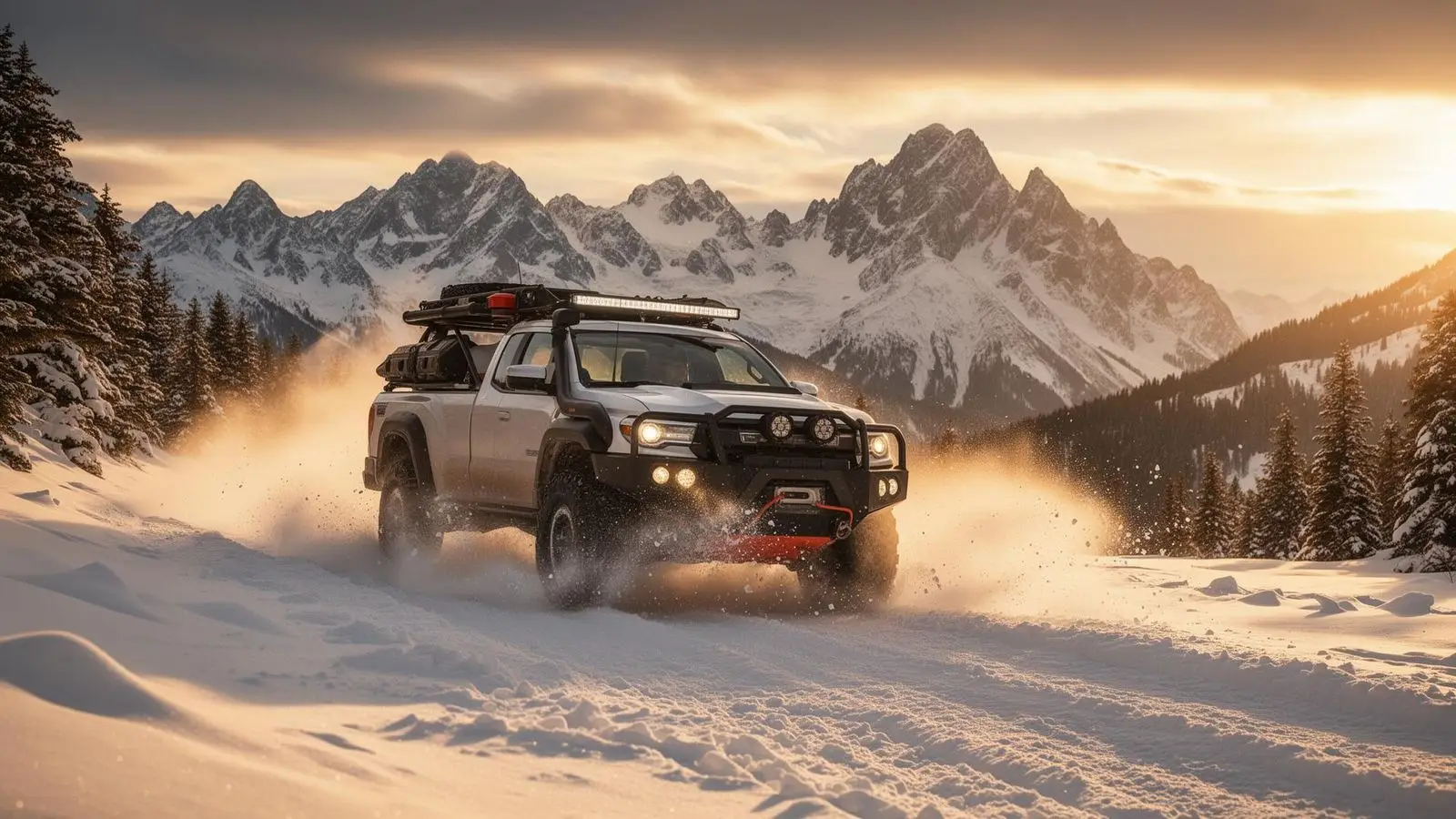
Winter transforms familiar trails into something beautiful and dangerous. The silence of fresh powder, the drama of frost-covered pines, the satisfaction of navigating terrain that keeps everyone else home. But winter also compresses every mistake into consequences that arrive faster and hit harder than any other season.
A minor misjudgment that costs you 30 minutes and some pride in July becomes a survival situation in January. Getting stuck in a creek bed at 3 PM with the sun dropping and temperatures falling isn't an inconvenience. It's a potentially life-threatening emergency that demands gear, skills, and judgment you need to develop before you need them.
This guide covers everything you need to wheel safely when temperatures drop: tire selection, driving techniques, recovery methods, and emergency preparedness. Read it before your first winter trip. Then read it again before your fifth, because complacency kills more experienced wheelers than inexperience kills beginners.
Understanding Winter Physics: Why Everything Changes
Winter driving isn't summer driving on a slippery surface. The fundamental physics of how your vehicle interacts with terrain changes in ways that catch people off guard, even experienced off-roaders.
Traction: The Numbers Are Brutal
Snow and ice reduce tire grip by 50-90% compared to dry terrain. But the relationship isn't simple, and understanding the variables keeps you safe:
- Fresh powder: Often provides surprising traction as tires compress snow against underlying terrain. This is the most forgiving winter condition.
- Packed snow: Moderate grip. Predictable behavior if you're smooth with inputs.
- Hard-pack and ice: The most dangerous conditions. Minimal grip, unpredictable behavior, and the surface where most winter accidents happen.
- Temperature matters critically: Ice near freezing (28-32 degrees F) is significantly more slippery than ice at 10 degrees F. A thin liquid layer forms on "warm" ice, creating a nearly frictionless surface. Counterintuitively, colder is safer.
- Transition zones: Where snow meets bare ground, or where shade creates ice patches on otherwise clear terrain. These catch you mid-turn or mid-brake when half your tires have grip and half don't.
The Most Dangerous Misconception in Winter Wheeling
This Kills People Every Winter
Many winter accidents follow the same pattern: driver confidently accelerates through a slippery section using 4WD, discovers they can't stop or turn at the other end, and slides into a ditch, tree, or embankment. Your 4WD will climb an icy hill impressively. Gravity doesn't care about your drive system on the descent.
Hidden Hazards Beneath the Surface
- Deep ruts fill with snow, appearing as gentle undulations until a wheel drops in
- Frozen water crossings hide unknown depths beneath snow cover
- Rocks, stumps, and drop-offs lurk beneath what looks like a smooth snowfield
- Ice shelves along creek banks support weight near the edge, then break suddenly over deeper water
Rule: Never assume you know the terrain beneath fresh snow. If you haven't driven the route in summer, walk questionable sections first.
Tire Selection: Your Most Critical Winter Decision
All-terrain tires are a compromise by design. They sacrifice winter performance for year-round versatility. The rubber compounds that provide excellent grip at 80 degrees F harden below 45 degrees F, losing pliability and grip exactly when you need it most. Aggressive mud-terrain patterns often clog with snow, transforming into smooth, nearly traction-free surfaces.
Winter Tire Options Compared
| Feature | Studded Winter | Studless Winter | Snowflake-Rated AT |
|---|---|---|---|
| Ice Performance | Excellent | Very Good | Fair |
| Deep Snow | Very Good | Excellent | Good |
| Wet/Dry Road | Fair | Good | Very Good |
| Road Noise | Very High | Moderate | Low-Moderate |
| Off-Road Capability | Limited | Limited | Good |
| Tread Life | 3-4 seasons | 4-5 seasons | 4-6 seasons |
| Legal Restrictions | Banned in some states | None | None |
| Top Picks | Nokian Hakkapeliitta 10 | Bridgestone Blizzak DM-V2 | Falken Wildpeak AT3W |
| Price Range (set of 4) | $600-$1,200 | $500-$1,000 | $700-$1,200 |
The Mountain Snowflake Symbol
Look for the three-peak mountain snowflake (3PMSF) symbol on the sidewall. This means the tire passed severe snow service testing, a standardized performance benchmark. The common "M+S" (mud and snow) marking on most all-terrains is a design designation, not a performance test. There's a real difference.
Some all-terrain tires carry both the M+S and the snowflake symbol, like the Falken Wildpeak AT3W, BFGoodrich KO2, and General Grabber ATX. These represent the best compromise for wheelers who need year-round capability with legitimate winter performance.
The Dedicated Set Strategy
Tire Chains: Your Emergency Backup
- Ladder-style chains: Easiest to install, adequate for most conditions. Peerless and SCC are reliable brands.
- Diamond-pattern chains: Better coverage and smoother ride. More expensive.
- V-bar or studded chains: Maximum traction on glare ice. Aggressive and hard on surfaces.
Critical: Practice installing chains in your driveway before you need them trailside in freezing rain at dusk. Fumbling with cold chains on a dark roadside is miserable and dangerous. Most chains install in 10-15 minutes once you've practiced.
Vehicle Preparation: The Winter Checklist
Systems That Need Attention
- Battery: Cold reduces capacity by up to 50%. Test CCA (cold cranking amps) rating. Optima YellowTop or Odyssey Extreme AGM batteries handle cold temperatures significantly better than flooded lead-acid. Clean terminals and apply dielectric grease.
- Cooling system: Ensure antifreeze protects to at least -34 degrees F. Test with a hydrometer, don't assume. Old coolant degrades.
- Fluids: Switch to synthetic fluids in transfer cases and differentials. Conventional fluids thicken in cold, increasing drag and reducing lubrication at startup. Use winter-weight washer fluid rated to -20 degrees F or below.
- Heater and defroster: Verify the heater core isn't partially clogged (reduced heat output is the symptom). Check that defroster ducts direct air properly to the windshield. Carry rubbing alcohol spray for instant exterior de-icing.
- Recovery points: Cold makes metal brittle, especially cast iron. Inspect for cracks or damage. Grease shackle pins and moving parts to prevent them from freezing solid.
- Wipers and lights: Winter-rated wiper blades resist ice buildup. Ensure all lights work and are clean. Winter days are short and visibility matters more.
Tire Pressure in Cold Weather
Tire pressure drops approximately 1 PSI for every 10-degree F temperature drop. If you set pressures in your 60-degree garage, you'll be 3-4 PSI low by the time you reach a 25-degree trailhead. Check and adjust at trail temperature, not home temperature.
- Snow flotation: 15-20 PSI provides maximum footprint for soft snow
- Ice and hard-pack: Slightly higher (20-25 PSI) for more edge bite from tread blocks
- Risk awareness: Extremely low pressures increase debeading risk on rocks hidden beneath snow
Winter Driving Techniques: Smooth Is Fast
Momentum Management: The Core Skill
The Winter Driving Mantra
Momentum is both your greatest ally and most dangerous enemy in winter. Controlled momentum carries you through soft snow sections that would bog you down at lower speeds. Excessive speed eliminates reaction time and transforms minor slides into unrecoverable situations.
Starting and Stopping
Starting on slippery surfaces:
- Apply throttle gently to avoid wheelspin. The moment tires break traction, ease off immediately and try again with less throttle.
- If your vehicle has a snow/ice mode or terrain management system, use it. These modes modify throttle response and traction control behavior for low-grip conditions.
- In deep snow, rocking (shifting between drive and reverse in short bursts) builds momentum to escape ruts. Be gentle. Aggressive rocking damages transmissions.
Stopping on slippery surfaces:
- Begin braking much earlier than on dry terrain. Triple your normal following distance at minimum.
- ABS-equipped vehicles: Maintain steady brake pressure and let the system work. Do not pump ABS brakes.
- Non-ABS vehicles: Use threshold braking: maximum pressure without locking wheels. If wheels lock, release and reapply with less force.
- Downshift to use engine braking before applying brake pedal. Engine braking is smoother and less likely to break traction than wheel brakes.
Hills: Where Winter Gets Serious
Uphill:
- Build momentum on the flat approach and carry it up the hill with steady, light throttle.
- If you lose traction and start sliding backward: steer straight downhill (don't try to turn), gently apply brakes, and come to a controlled stop. Then reassess.
- Never attempt to turn around on a steep, slippery slope. Back down the way you came.
Downhill:
- Engage low range and first gear before the descent. Engine braking is your primary speed control.
- Supplement with gentle brake pressure. Never rely solely on brakes for speed control on a slippery descent.
- If you begin sliding: momentarily release the brake to allow wheel rotation (a locked wheel cannot steer), point the wheels where you want to go, then reapply brakes gently.
- Steep icy descents are the single most dangerous winter driving scenario. When in doubt, walk the hill first and honestly assess whether you can control a descent.
Water Crossings in Winter
Winter water crossings present unique hazards that demand extra caution:
- Ice shelves may support vehicle weight near banks, then break suddenly in deeper sections
- Currents run stronger under ice, with hidden depth variations
- Water temperatures near freezing induce cold shock in seconds if you break through
- Wet components (brakes, belts, electrical connections) freeze quickly after crossing
Winter Crossing Rules
- Test ice thickness with a probe before committing (4 inches of clear ice minimum for a vehicle)
- Never cross alone. Have recovery equipment rigged and ready on the far bank.
- Maintain steady momentum. Do not stop mid-crossing.
- Open windows slightly for a quick escape if the vehicle breaks through
- Carry dry clothing in waterproof bags in case of immersion
When in doubt, find another route. A flooded engine in winter becomes an emergency extraction scenario, and your vehicle is your primary shelter. Losing it to a bad water crossing can be life-threatening.
Winter Recovery: Different Rules Apply
Self-Recovery in Snow and Ice
The biggest mistake in winter recovery is aggressive throttle. Spinning wheels dig deeper ruts and polish ice surfaces into glass. Be methodical:
- Assess: What's limiting traction? Soft powder? Hard-pack? Ice? The answer determines your strategy.
- Clear: Shovel snow from in front of and behind all four tires. Create gradual ramps, not vertical walls. A metal-edged shovel is essential because plastic breaks in frozen conditions.
- Add traction: Place MaxTrax, ARB Tred Pro, or X-Bull traction boards in your intended path. Position them so tires climb onto the textured surface. In a pinch, sand, kitty litter, or wood ashes provide grip on ice.
- Air down: If not already, reduce to 15-20 PSI for maximum footprint.
- Attempt: Minimal throttle in low range. If tires spin, stop immediately and reassess. Rocking between drive and reverse can build momentum, but keep it gentle.
Vehicle-to-Vehicle Recovery: Winter Modifications
- Frozen gear: Tow straps freeze rigid and become difficult to handle. Shackles ice up and may not thread properly. Keep all recovery gear inside the cab to maintain warmth and flexibility.
- Synthetic rope advantage: Synthetic winch rope handles cold better than steel cable, which becomes brittle and less flexible in extreme cold.
- Footing for the recovery vehicle: The pulling vehicle needs traction too. Position it on the most solid ground available. Consider chaining up the recovery vehicle before attempting the pull.
Critical Winter Recovery Safety
Emergency Preparedness: Plan for an Unplanned Overnight
The golden rule of winter wheeling: always carry enough gear to survive an unplanned night in your vehicle. Mechanical failures, unexpected storms, injuries, or impassable conditions can strand you far from help. In winter, "far from help" can mean "dangerously cold within hours."
Winter Emergency Kit
| Category | Essential Items | Why It Matters |
|---|---|---|
| Warmth | Sleeping bags rated -20F, insulated boots, wool blankets, chemical warmers | Hypothermia develops in hours, not days |
| Shelter | Emergency bivvy, windproof tarp, duct tape for window repair | Wind chill multiplies cold exposure danger |
| Fire | Waterproof matches, ferro rod, fire starters, small firewood bundle | Fire provides heat, light, signaling, and morale |
| Nutrition | High-calorie bars (Clif, ProBar), hot cocoa packets, instant soup | Your body burns 2-3x calories shivering to stay warm |
| Tools | Metal-edged shovel, traction boards, tow strap, ice scraper | Plastic shovels shatter in frozen conditions |
| Communication | Garmin inReach Mini 2, fully charged power bank (kept warm), flares | Cell service disappears in winter backcountry |
Vehicle Survival Priorities
- Your 4x4 provides shelter superior to any tent in winter conditions. Stay with it.
- Run the engine periodically for heat: 15 minutes per hour conserves fuel while maintaining livable cabin temperatures.
- Critical: Ensure the exhaust pipe remains clear of snow to prevent carbon monoxide buildup. Check regularly. Crack a downwind window slightly when the engine is running.
- Winter idling consumes 0.5-1 gallon per hour. Calculate your available runtime and ration accordingly. Extra fuel cans extend your survival window dramatically.
Hypothermia: The Quiet Emergency
Hypothermia develops when core body temperature drops below 95 degrees F. It develops insidiously, especially when sweat-soaked clothing chills the body after physical exertion like shoveling or recovery work.
Early signs to watch for in yourself and others:
- Uncontrollable shivering (this is your body's first defense and a clear warning)
- Confusion, poor decision-making, unusual irritability
- Fumbling with gear, loss of fine motor control
- Paradoxically feeling warm and wanting to remove clothing (late stage, extremely dangerous)
Response:
- Get the person dry and warm immediately. Replace all wet clothing with dry layers.
- Provide warm (not hot) liquids if conscious.
- Skin-to-skin contact inside a sleeping bag provides the most effective rewarming.
- Severe hypothermia requires gentle handling. Rough movement can trigger cardiac arrest in someone with dangerously low core temperature.
Environmental Responsibility in Winter
Avalanche Awareness
Mountain terrain in winter carries avalanche risk that demands respect and education. This is not something you can wing.
- Check local avalanche forecasts before entering mountain terrain (avalanche.org provides regional forecasts)
- Carry an avalanche transceiver, probe, and shovel if traveling in avalanche country
- Travel with partners and maintain visual contact
- Avoid slopes between 30-45 degrees during high or considerable danger ratings
- Never stop in avalanche runout zones (the flat areas at the bottom of steep slopes)
Avalanche Education
Trail Preservation
- Frozen ground doesn't absorb impacts like thawed soil, increasing erosion potential
- Snow cover protects vegetation that would be destroyed by summer vehicle traffic
- Stay on designated winter routes and avoid creating new tracks through sensitive areas
- Ruts created in frozen mud become permanent scars when the ground thaws
The Winter Wheeling Mindset
Winter 4x4 adventures offer experiences impossible to replicate in other seasons. The solitude of empty trails. The beauty of landscapes transformed by snow. The quiet satisfaction of navigating conditions that keep everyone else at home.
But winter demands a mindset shift that summer wheeling doesn't require. The margin for error shrinks dramatically. Mechanical problems become emergencies. Getting stuck becomes dangerous. The remote locations that define great overlanding put you hours or days from rescue if things go wrong.
Approach winter wheeling with:
- Proper equipment: Winter tires or snowflake-rated ATs, emergency survival gear, and a vehicle prepared for cold
- Practiced skills: Momentum management, smooth inputs, winter recovery techniques
- Conservative decision-making: When conditions approach your limit, that's the time to turn back, not push forward
- Honest self-assessment: Ego has no place on an icy mountain road. Know your limits and respect them.
The mountain, the trail, and the storm will still be there when you're better prepared. Make sure you are too.