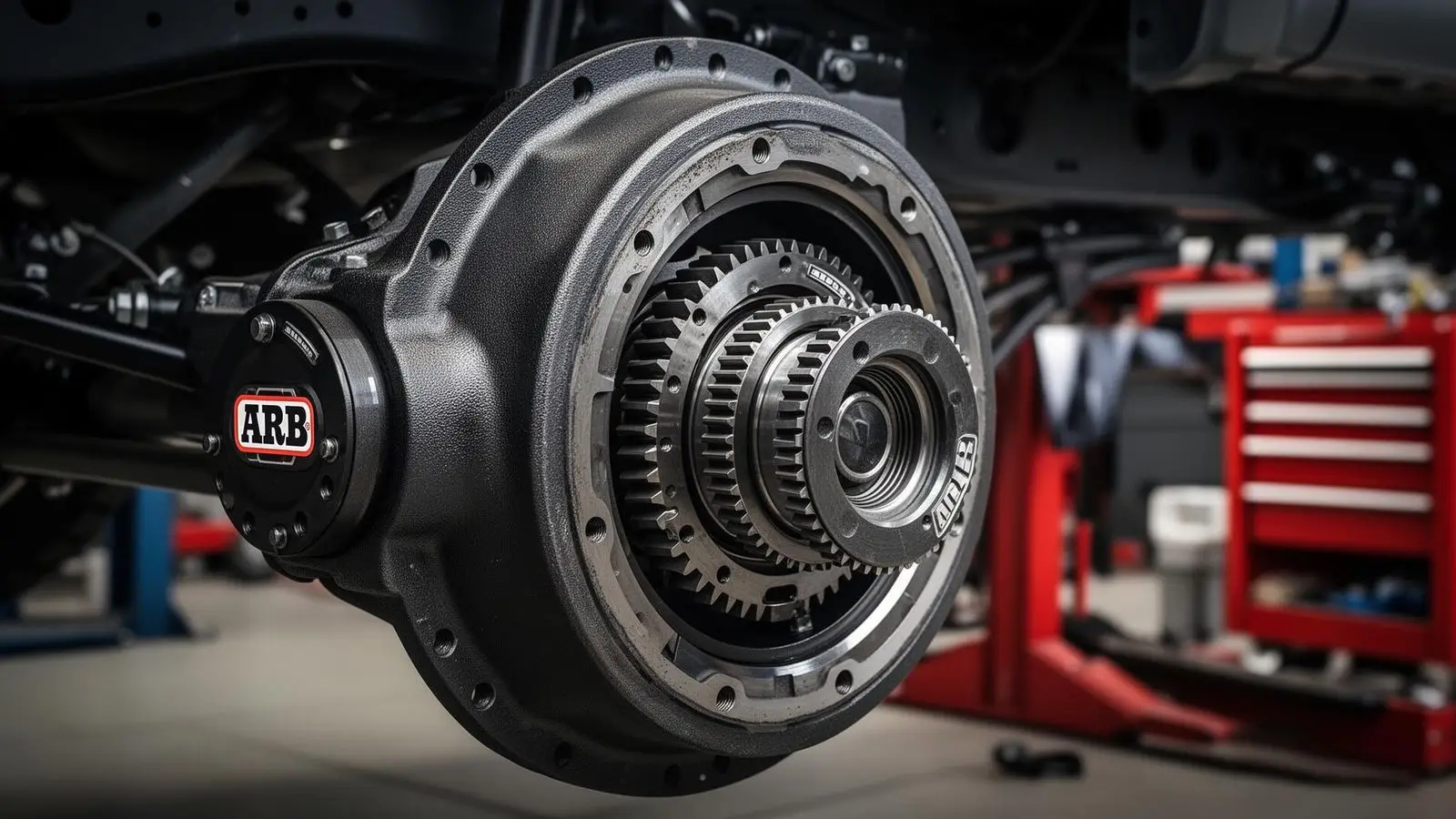
Nothing ruins a trail day faster than one wheel spinning uselessly while the other three sit motionless. Open differentials are designed for street driving, they send power to the wheel with the least resistance, which is exactly the opposite of what you need off-road.
Lockers fix this problem by forcing both wheels on an axle to turn together.
But with air lockers, electric lockers, and automatic lockers all competing for your money, which one is actually right for your build? Here's the complete breakdown.
How Lockers Work (Quick Overview)
A standard open differential splits power between two wheels, always sending torque to the wheel that's easiest to spin. Great for turning on pavement, terrible when one wheel is on ice or in the air.
Lockers mechanically connect both axle shafts so they rotate at the same speed. When locked, 100% of available torque goes to both wheels equally, if one has traction, you're moving.
The Three Main Locker Types
1. Air Lockers (Pneumatic)
Air lockers use compressed air to engage a locking mechanism inside the differential. They're "selectable",you choose when to lock and unlock via a dash-mounted switch.
How They Work
An onboard air compressor sends air through lines to the differential. When you flip the switch, air pressure pushes a collar that locks the side gears together. Release the switch, and springs disengage the lock.
Popular Air Locker Brands
| Brand | Price Range | Notes |
|---|---|---|
| ARB Air Locker | $1,200, $1,600 | Industry standard, excellent reliability, wide application coverage |
| Yukon Zip Locker | $800, $1,100 | Cable-actuated (no compressor needed), budget-friendly |
| OX Locker | $900, $1,200 | Cable-actuated, available in air version too |
Pros
- 100% open differential behavior when unlocked, no daily driving compromises
- Instant on/off engagement
- Can be engaged/disengaged at any speed (when stopped)
- Most proven technology with decades of trail use
- Compressor can be used for airing up tires, tools, etc.
Cons
- Higher cost (locker + compressor + lines + switches)
- More complex installation with air lines and electrical
- Air lines can be damaged on aggressive trails
- Compressor is another component that can fail
- Requires stopping to engage/disengage
Best For
2. Electric Lockers (E-Lockers)
Electric lockers use an electromagnet or electric motor to engage the locking mechanism. Like air lockers, they're selectable via a dash switch.
How They Work
When you press the switch, electrical current activates a mechanism that locks the differential. Some use electromagnets (Eaton E-Locker), others use small electric motors (Auburn ECTED).
Popular Electric Locker Brands
| Brand | Price Range | Notes |
|---|---|---|
| Eaton E-Locker | $900, $1,300 | OEM supplier, reliable, good coverage |
| Auburn ECTED Max | $700, $1,000 | Electric motor actuation, acts as LSD when unlocked |
| Harrop E-Locker | $1,100, $1,400 | Australian made, premium quality |
Pros
- Simpler installation than air lockers, just electrical wiring
- No compressor, tanks, or air lines to install or maintain
- Lower total system cost than air lockers
- 100% open when unlocked (on most models)
- Less external components to damage on the trail
Cons
- Dependent on vehicle electrical system
- Some models have slightly slower engagement
- No secondary use (unlike compressor for air tools/tires)
- Fewer application-specific options than ARB
Best For
3. Automatic Lockers
Automatic lockers are "always on",they lock both wheels together by default and only unlock when specific conditions are met (like turning). No switches, no driver input required.
How They Work
Various mechanisms allow the inside wheel to "ratchet" or unlock during turns while maintaining lock under straight-line power. They automatically re-lock when wheels straighten out.
Popular Automatic Locker Brands
| Brand | Price Range | Notes |
|---|---|---|
| Eaton Detroit Locker | $400, $700 | The original, aggressive locking, proven reliability |
| Eaton Detroit TrueTrac | $400, $600 | Helical gear LSD,not a true locker but very capable |
| Yukon Grizzly | $350, $550 | Aggressive, affordable, good for dedicated trail rigs |
| Spartan Locker | $200, $350 | Drop-in lunch box style, budget option |
| Lock-Right | $250, $400 | Drop-in, uses existing carrier, easy install |
Pros
- Lowest cost option
- Simplest installation, no wiring, no air lines
- Always ready, no forgetting to engage
- No external components to fail or damage
- Some styles (lunch box) use existing carrier
Cons
- Clicking/banging noise when turning (especially tight turns)
- Affects on-road handling, can be unpredictable in wet/icy conditions
- Increased tire wear from binding in turns
- Can't be unlocked, it's always "on"
- Not recommended for front axle (steering issues)
Daily Driver Warning
Full Comparison Table
| Feature | Air Locker | E-Locker | Auto Locker |
|---|---|---|---|
| Locker Cost | $800, $1,600 | $700, $1,300 | $200, $700 |
| Compressor/System Cost | $300, $600 | $0 | $0 |
| Install Labor | $500, $900 | $400, $700 | $300, $600 |
| Total Installed (One Axle) | $1,600, $3,100 | $1,100, $2,000 | $500, $1,300 |
| Selectable | Yes | Yes | No |
| Street Manners | Excellent | Excellent | Poor |
| Install Complexity | High | Medium | Low, Medium |
| Reliability | Excellent | Excellent | Good, Excellent |
| Best For | Daily/Trail combo | Trail focused | Dedicated trail rig |
Front Locker vs Rear Locker: Which First?
Rear Locker First (Recommended)
Most people should start with a rear locker:
- Provides the biggest traction improvement
- No steering side effects
- Works on all terrain types
- Lower risk of damage from misuse
Front Locker Considerations
Front lockers add capability but change driving dynamics:
- Steering becomes heavy and resistant when locked
- Can cause axle hop on hard surfaces
- Should be unlocked for most driving, even off-road
- Best engaged only when truly needed (rock crawling, deep mud)
The Reality
Installation Considerations
Do It With Re-Gearing
If you're planning to re-gear for bigger tires, install your locker at the same time. The differential is already open, you'll save $300, $500 in labor by combining the jobs.
DIY Feasibility
- Lunch box lockers (Spartan, Lock-Right): DIY-friendly, uses existing carrier
- Full carrier lockers (Detroit, ARB): Requires gear setup knowledge
- Air/electric systems: Locker install is the same; wiring/plumbing adds complexity
What You'll Need for DIY
- Dial indicator and magnetic base (for gear setup)
- Inch-pound torque wrench (for pinion preload)
- Bearing puller set
- Gear marking compound
- Quality service manual for your specific axle
Our Recommendations by Use Case
Daily Driver + Weekend Warrior
Best choice: ARB Air Locker or Eaton E-Locker (rear only)
You need selectable locking to maintain street manners. The extra cost is worth it for a vehicle you drive every day. Start with rear only.
Dedicated Trail Rig
Best choice: Detroit Locker rear, selectable front
If it rarely sees pavement, an automatic rear locker is fine. But keep the front selectable for steering control. This combo maximizes traction while maintaining control.
Budget Build
Best choice: Spartan or Lock-Right (rear only)
Lunch box lockers give you 80% of the capability for 20% of the cost. Accept the on-road quirks and save your money for other mods. Upgrade later if needed.
Rock Crawler
Best choice: ARB front and rear
Precise control matters on the rocks. Being able to unlock for tight turns and technical lines is worth the investment. Air system does double duty for tire inflation.
The Bottom Line
Lockers transform off-road capability more than almost any other single mod. But choose the right type for your actual use:
- Daily driver: Spend more for selectable (air or electric)
- Trail-only: Automatic lockers offer great value
- Rear first: Unless you're rock crawling, rear locker alone is transformative
- Combine with re-gearing: Save labor by doing both at once
Don't overthink it. Any locker is dramatically better than an open differential when the going gets tough. Pick one, install it, and go enjoy the trails you couldn't tackle before.