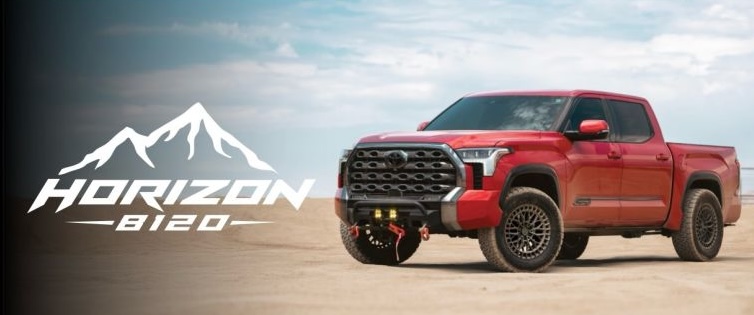
Everybody looks at the face. Nobody looks at the number. The Mayhem Horizon 8120 is a good looking wheel, and if you are shopping for it you have probably already decided that. But the thing that decides whether you love this wheel or spend a Saturday with a fender roller is not the finish. It is the three offsets Mayhem chose, because they are wildly different from each other.
What the Horizon 8120 Actually Is
Mayhem is one of eight brands under The Wheel Group, the Ontario, California outfit that also owns Dirty Life, Cali Off Road, American Truxx, ION, AMP Tires, Body Armor 4x4, and Tuff Stuff Overland. Mayhem's lane inside that portfolio has always been the aggressive-styled half-ton truck: real load ratings, real certification standards, styling that leans hard, and a price that does not require a family meeting.
The 8120 Horizon is one of the newest styles in the lineup, and it is a design departure. Where most of Mayhem's catalog is chunky and mechanical, with visible hardware and simulated beadlock rings, the Horizon goes the other direction. It is a deep concave multi-spoke with vented windows cut behind the spoke faces, a look borrowed from the street and performance wheel world and dropped onto a 6-lug truck bolt pattern. Concavity creates the visual depth. The vented windows keep it from looking like a mall crawler wheel. At launch it is gloss black and only gloss black.
The Full Spec Sheet
| Size | Bolt pattern | Offset | Backspacing | Center bore | Load rating |
|---|---|---|---|---|---|
| 18x9 | 6x135 / 6x139.7 | +18 | 5.71 in | 87.1 / 106 mm | 2,500 lbs |
| 20x9 | 6x139.7 | +0 | 5.00 in | 106 mm | 2,500 lbs |
| 20x9 | 6x139.7 | +18 | 5.71 in | 106 mm | 2,500 lbs |
| 22x10 | 6x139.7 | -19 | 4.75 in | 106 mm | 2,500 lbs |
Finish is Gloss Black across the range. Construction is cast aluminum, built to OEM, ISO, SAE, JWL, VIA, and TUV standards, the same certification set the rest of the Mayhem catalog carries. Two things in that table matter more than the rest: the 2,500 pound load rating, and the fact that the offsets range across 37 millimeters.
The Honest Truth: This Is Three Different Wheels
Wheel companies list offsets like they are trim levels. They are not. Offset is how far the mounting face sits from the wheel's centerline. Positive offset tucks the wheel in toward the suspension. Negative offset pushes it out toward the fender. Backspacing measures the same thing from the other direction, from the mounting face to the inner lip.
The 20x9 +18 has 5.71 inches of backspacing. A factory Silverado 1500 RST wheel is a 20x9 at +28, so the Horizon sits about 10 millimeters further out per side. That is a nothing change. This is the conservative fitment that works on a stock or lightly leveled half-ton without drama, and the one most people should probably buy.
The 20x9 +0 has 5.00 inches of backspacing and puts the wheel a full 28 millimeters, about 1.1 inches, outboard of that same stock Silverado position. On a leveled truck with a 33 or 34 inch tire, that reads as a purposeful stance without looking like you did too much.
The 22x10 -19 is the one to think hard about. At 4.75 inches of backspacing, its outer face sits roughly 2.3 inches further out than a stock Silverado 20x9. Put it on a Tundra, which runs a very tucked +60 offset from the factory, and the outer face moves out by right around four inches per side compared to stock. That is not a stance. That is a commitment.
None of that is a criticism. It is a spec doing exactly what it was designed to do. But it means "I want the Horizon" is not a purchase decision yet.
What Fits What
The 6x139.7 pattern covers Toyota Tundra, Tacoma, 4Runner, Sequoia, and FJ Cruiser, plus Chevy Silverado 1500 and GMC Sierra 1500, Chevy Colorado and GMC Canyon, and Nissan Titan and Frontier. The 6x135 pattern, offered on the 18x9 only, covers Ford F-150 from 2004 up, Expedition, and Navigator. Worth stating plainly: the 8120 in its current drills does not fit a Wrangler JL or a Gladiator. Those are 5x127.
Here is the detail nobody advertises. The 6x139.7 versions have a 106 millimeter center bore, which is a Toyota-sized hub. Toyota's 6-lug hubs measure 106.1 millimeters, so the wheel seats hub-centric on a Tundra or 4Runner with nothing extra. GM and Nissan 6-lug hubs measure 78.1 millimeters. On a Silverado, Sierra, Colorado, Canyon, Titan, or Frontier you need 78.1 to 106 hub-centric rings, and you should absolutely use them. Lug-centric mounting on a heavy 22 inch wheel is how you end up chasing a vibration you will never balance out. Rings cost about fifteen dollars.
The Warts
The 2,500 pound load rating is the ceiling. That is 10,000 pounds across four corners, which comfortably clears the GAWR on any half-ton this fits. It is also below Mayhem's own Warrior, rated to 3,640 pounds for 40 inch tire applications. Do not put it on an F-250, do not hang 40s off it, and do not load a slide-in camper on a set.
It is cast, not forged, and not a beadlock. Nothing wrong with that at this price, and cast wheels have hauled trucks over rocks for decades. But if you air down to single digits, this is not the answer. Mayhem's own copy describes the Horizon as strong street presence with off-road capability, and that ordering is honest.
Gloss black only. Gloss shows curb rash more readily than satin, and the deep concave face puts the outer edge closer to the curb than a flat-faced wheel does.
Those vented windows collect everything. The detail that makes the wheel look expensive is also a set of pockets for brake dust, trail mud, and road salt.
Negative offset has a bill. Pushing the wheel out increases scrub radius, which means more steering effort at low speed, more tug at the wheel when one tire hits a rut, and more leverage on your wheel bearings and ball joints. It also pushes the tire past the fender line, which throws mud and rock up your paint and, in some states and Canadian provinces, runs into tire coverage regulations.
Who Should Buy Which
| Your truck | Pick | Why |
|---|---|---|
| Stock or leveled F-150 on 33s | 18x9 +18 (6x135) | Only Ford drill offered, conservative fitment, cheapest tire sizes |
| Stock or leveled Tacoma / 4Runner | 18x9 +18 (6x139.7) | Keeps sidewall for trail use, no trimming |
| Leveled Silverado / Sierra / Tundra on 33s | 20x9 +18 | Near-stock fitment, no fender work, add hub rings on GM |
| Leveled half-ton wanting visible stance | 20x9 +0 | About 1.1 in more poke than stock, still streetable |
| Lifted truck, show-first build | 22x10 -19 | Maximum face, maximum poke, plan on flares and possible trimming |
| HD truck, 37s or bigger, hard trail use | None of them | 2,500 lb rating and 6-lug drills put this outside the brief |
If you are between the 20x9 +18 and the 20x9 +0, ask one question: do you already have a leveling kit or lift on the truck? If the answer is no, take the +18. A level or small lift is what buys the fender room that makes the +0 look right instead of crowded.
Where the 22s Make Sense and Where They Do Not
A 22x10 wheel means a short sidewall, and a short sidewall means you cannot air down meaningfully without risking a bead and a bent lip. On a truck that sees fire roads, washboard, and the occasional rocky two-track, that is a real limitation, not a theoretical one. Sidewall is the actual off-road currency, and 22s spend most of it before you leave the driveway.
The 22x10 -19 Horizon is for the truck that lives on pavement and looks like it does not. That is a legitimate build and a huge chunk of the market. Just do not buy the 22s and then plan a Moab trip. For anything that actually goes off pavement with regularity, the 18x9 +18 is quietly the smartest wheel in this lineup.
The Verdict
The Horizon 8120 is a well-styled cast truck wheel from a brand that knows this segment, and the deep concave face with vented windows is a genuinely fresh look on a 6-lug pattern. Gloss black only is a limitation, the 2,500 pound rating caps it at half-ton duty, and the 22x10 is a pavement wheel wearing off-road clothes. But the buying advice is simpler than any of that: ignore the render, look at the offset, and be honest about what your truck is.