The Real Cost of Deleting Your Diesel Truck (No BS)
Bottom Line Up Front
But here's what most articles won't tell you: the cost of the delete is just the beginning. You'll also need to consider:
- Tuning costs ($400-700)
- Potential warranty void (could cost you $10,000+ in denied claims)
- Legal risks (EPA fines up to $50,000)
- Failed emissions testing (where applicable)
- Resale value impact
What is a Diesel Delete? (5-Minute Explanation)
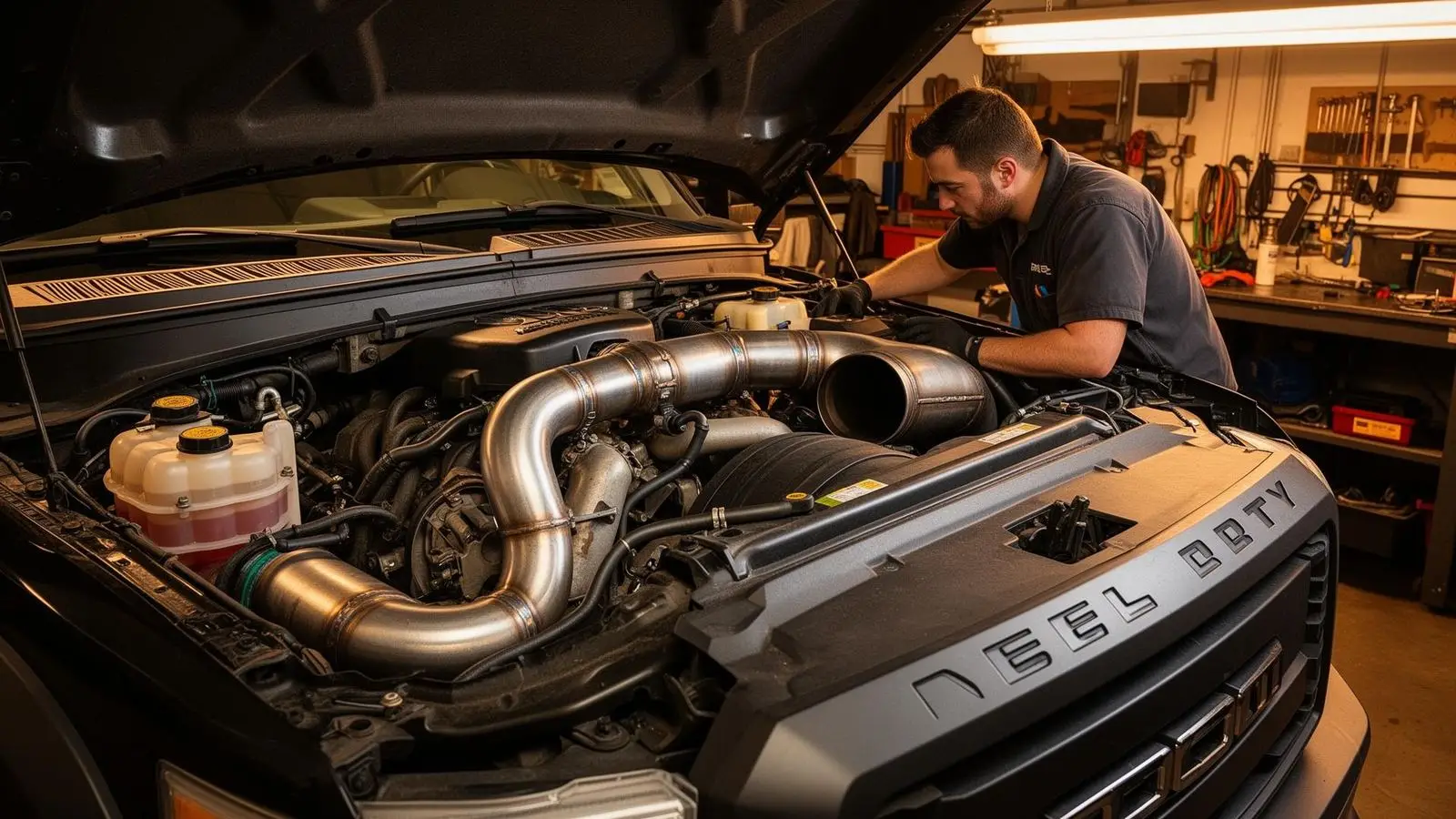
Diesel deletion means removing or disabling the emissions control systems that came factory-installed on your truck. These systems were mandated by the EPA starting in 2007-2008 to reduce diesel emissions.
The Three Main Systems People Delete
1. DPF Delete (Diesel Particulate Filter)
What it does: Traps soot particles in the exhaust
Why people delete it:
- Requires regeneration (burns trapped soot)
- Reduces power and fuel economy
- Expensive to replace ($2,000-4,000)
- Can clog and cause limp mode
What deletion involves:
- Remove DPF canister
- Install straight pipe (DPF delete pipe)
- Tune ECU to disable DPF monitoring
2. EGR Delete (Exhaust Gas Recirculation)
What it does: Recirculates exhaust gases back into intake
Why people delete it:
- Causes carbon buildup in intake
- Reduces engine efficiency
- Can fail and cost $1,500-2,500 to replace
- Lowers combustion temperatures (less power)
What deletion involves:
- Remove EGR valve and cooler
- Block off EGR passages
- Install intake elbow or up-pipe
- Tune ECU to disable EGR codes
3. DEF Delete (Diesel Exhaust Fluid System)
What it does: Injects urea solution to reduce NOx emissions
Why people delete it:
- DEF system failures cause limp mode
- DEF costs $12-15 per gallon
- Sensors and pumps fail frequently
- Freezes in cold weather
What deletion involves:
- Remove DEF tank, lines, and injector
- Tune out DEF monitoring
- Some keep tank for weight/appearance
Complete Cost Breakdown by Engine
6.7L Powerstroke Delete Cost (2011-2024)
Total Cost Range: $1,400 - $3,000
Parts Cost (DIY):
| Component | Price Range |
|---|---|
| DPF Delete Pipe | $300-600 |
| EGR Delete Kit | $200-400 |
| DEF Delete (if applicable) | $100-200 |
| Tuner/Programmer | $400-700 |
| Miscellaneous (clamps, gaskets) | $50-100 |
| Total DIY Parts | $1,050-2,000 |
Labor Cost (Professional Installation):
| Service | Hours | Cost |
|---|---|---|
| DPF/EGR Installation | 3-5 hours | $300-600 |
| Tuning | 1 hour | $100-200 |
| Total Labor | 4-6 hours | $400-800 |
Total Professional Installation: $1,450-2,800
6.6L Duramax Delete Cost (LML, L5P 2011-2024)
Total Cost Range: $1,500 - $3,000
Parts Cost (DIY):
| Component | Price Range |
|---|---|
| DPF Delete Pipe | $400-700 |
| EGR Delete Kit | $250-450 |
| Up-Pipe (LML/L5P) | $200-350 |
| Tuner | $500-800 |
| CCV Reroute (recommended) | $150-250 |
| Total DIY Parts | $1,500-2,550 |
Labor Cost (Professional): Installation: $400-900 (4-6 hours at $100-150/hour)
Total Professional: $1,900-3,450
Why Duramax Costs More
- More complex installation
- Requires up-pipe replacement
- Tighter engine bay
- More expensive tuners
6.7L Cummins Delete Cost (2007.5-2024)
Total Cost Range: $1,200 - $2,800
Parts Cost (DIY):
| Component | Price Range |
|---|---|
| DPF Delete Pipe | $300-550 |
| EGR Delete Kit | $200-400 |
| Intake Grid Heater Delete | $100-200 |
| Tuner | $400-650 |
| Miscellaneous | $50-100 |
| Total DIY Parts | $1,050-1,900 |
Labor Cost (Professional): Installation: $300-700 (3-5 hours)
Total Professional: $1,350-2,600
Why Cummins is Cheapest
- Easier to access components
- Inline-6 engine (simpler layout)
- Large aftermarket support
- Less complex than V8 diesels
DIY vs Professional Installation: Which Should You Choose?
DIY Installation
Realistic Time Required:
- First time: 6-10 hours
- Experienced: 4-6 hours
- Includes tuning time
Tools You'll Need:
- Socket set (metric and standard)
- Torque wrench
- Jack and jack stands
- Sawzall or cutting wheel (sometimes)
- Laptop with tuning software
- OBD-II cable
Money Saved: $400-800
DIY Pros
- Save $400-800 in labor
- Learn your truck inside and out
- Can customize installation
- Do it on your schedule
DIY Cons
- Time-consuming (full day project)
- Risk of mistakes (expensive to fix)
- Need proper tools
- No warranty on labor
- Tuning mistakes can damage engine
Professional Installation
What to expect:
- Drop off truck in morning
- Pick up same day or next day
- Typically includes test drive
- Some shops offer tuning adjustments
Cost: $400-900 depending on engine and shop
Recommendation
DIY if you: Have mechanical experience, own the necessary tools, have a full weekend available, want to save $400-800
Professional if you: Lack mechanical experience, don't have proper tools, use truck for work (can't have downtime), want warranty protection
Performance Gains: What You Actually Get
Horsepower & Torque Gains
With delete and basic tune:
| Engine | Stock HP/TQ | With Delete | Gain |
|---|---|---|---|
| 6.7 Powerstroke | 475 hp / 1,050 lb-ft | 550-600 hp / 1,150-1,250 lb-ft | +75-125 hp / +100-200 lb-ft |
| 6.6 Duramax L5P | 445 hp / 910 lb-ft | 525-575 hp / 1,050-1,150 lb-ft | +80-130 hp / +140-240 lb-ft |
| 6.7 Cummins | 370 hp / 850 lb-ft | 450-500 hp / 1,000-1,100 lb-ft | +80-130 hp / +150-250 lb-ft |
Note: Gains vary based on tuning aggressiveness
Fuel Economy Improvements
Real-world results:
- Highway driving: Improvement: 2-4 mpg (Example: 16 mpg → 18-20 mpg)
- City driving: Improvement: 1-2 mpg (Less noticeable than highway)
- Towing heavy: Improvement: 1-3 mpg (More consistent power delivery)
Annual Fuel Savings
Throttle Response
Before delete:
- Laggy throttle (DPF regeneration)
- Inconsistent power
- Hesitation when accelerating
After delete:
- Immediate throttle response
- Linear power delivery
- No more regen interruptions
Engine Longevity Benefits
Reduced wear on:
- EGR system (no carbon buildup)
- Turbocharger (cleaner intake air)
- Pistons (less heat from EGR)
- Oil (stays cleaner longer)
Prevented failures:
- DPF clogging ($2,500-4,000 replacement)
- EGR cooler failure ($1,500-2,500 repair)
- Turbo failure from carbon ($2,000-3,500)
Legal Considerations: What You MUST Know
Federal EPA Regulations
The Law is Clear
⚠️ Tampering with emissions equipment is illegal under the Clean Air Act
This applies to: All 50 states, street-legal registered vehicles, even if your state has no emissions testing.
Potential penalties:
- Individual fines: Up to $2,500 per violation
- Shop fines: Up to $25,000-50,000
- Multiple violations stack
EPA enforcement actions (2020-2024):
- Increased focus on delete shops
- Several major shops shut down
- $500,000+ fines issued
- Criminal charges in some cases
The "Off-Road Use Only" Disclaimer
What manufacturers claim:
- Delete kits are for "off-road, racing, or agriculture use only"
- Not intended for street-legal vehicles
The reality:
- Most deleted trucks remain street-registered
- Hard for EPA to enforce individual cases
- Enforcement focused on shops, not owners
- Risk is low but not zero
State-by-State Differences
States with emissions testing: California, Colorado, Connecticut, Delaware, Georgia, Idaho, Illinois, Indiana, Louisiana, Maine, Maryland, Massachusetts, Missouri, Nevada, New Hampshire, New Jersey, New Mexico, New York, North Carolina, Ohio, Oregon, Pennsylvania, Rhode Island, Tennessee, Texas, Utah, Vermont, Virginia, Washington, Wisconsin
States without emissions testing: Alaska, Alabama, Arkansas, Florida, Iowa, Kansas, Kentucky, Michigan, Minnesota, Mississippi, Montana, Nebraska, North Dakota, Oklahoma, South Carolina, South Dakota, West Virginia, Wyoming
Important: Federal law still applies in all states
Hidden Costs Nobody Mentions
1. Voided Warranty
What gets voided:
- Entire powertrain warranty
- Emissions warranty
- Potentially entire vehicle warranty
Cost impact:
- Engine failure: $15,000-25,000
- Transmission failure: $5,000-8,000
- Turbo failure: $2,500-4,000
When It Matters
2. Failed Emissions Testing
In states with testing, inspection failure means:
- Can't renew registration
- Truck is illegal to drive
- Must reinstall emissions equipment
Cost to reverse:
- Parts: $2,000-4,000 (used DPF/EGR)
- Labor: $500-1,000
- Tuning back to stock: $200-400
- Total: $2,700-5,400
3. Increased Maintenance Costs
What increases:
- Oil changes (more frequent needed)
- Fuel filter changes (critical for CP4 pumps)
- Air filter changes (more airflow)
Annual increase: $200-400
4. Resale Value Impact
Selling a deleted truck:
Pros
- Performance-minded buyers pay premium
- Enthusiast market values modifications
- Can add $2,000-5,000 to private sale price
Cons
- Can't trade to dealer (will require re-installation)
- Limits buyer pool
- Some states require emissions compliance
- Banks may not finance modified trucks
Recommendation: Keep stock parts for resale
Step-by-Step Installation Guide
Tools Required
Essential:
- Socket set (10mm to 24mm)
- Torque wrench
- Jack and jack stands (rated for truck weight)
- Laptop with tuning software
- OBD-II cable
Helpful:
- Impact wrench
- Penetrating oil (PB Blaster)
- Wire brush
- Shop towels
- Drain pan (for coolant)
Installation Steps Overview
Phase 1: DPF Delete (2-3 hours)
- Lift and secure truck - Jack up rear, place on jack stands, check stability
- Remove DPF canister - Disconnect sensors (4-6 sensors typical), remove clamps, drop canister (heavy - 40-60 lbs)
- Install delete pipe - Fit new straight pipe, torque clamps to spec (typically 65-75 lb-ft), leave sensors disconnected
Phase 2: EGR Delete (2-4 hours)
- Drain coolant - EGR cooler has coolant lines, drain 1-2 gallons into pan
- Remove EGR valve and cooler - Disconnect vacuum lines, remove coolant lines, unbolt EGR valve
- Install block-off plates - Clean mounting surfaces, install new gaskets, bolt on plates
- Refill coolant - Add fresh coolant, burp system (remove air pockets)
Phase 3: Tuning (1-2 hours)
- Connect tuner to OBD-II port - Key on, engine off
- Read stock file (CRITICAL) - Save factory tune to computer, make multiple backups
- Load delete tune - Follow tuner instructions, usually takes 10-20 minutes, do not interrupt process
- Test start engine - Check for codes, verify no check engine light, let idle for 10 minutes
Common Installation Mistakes
- Not saving stock tune - Can't return to stock, may need to pay for new tune
- Over-torquing bolts - Cracks manifolds or pipes, expensive to replace
- Forgetting to disconnect sensors - Causes check engine lights, may damage sensors
- Not burping coolant system - Air pockets cause overheating, can damage engine
- Rushing the tuning process - Interrupted flash bricks ECU, requires professional recovery
Final Recommendations
Who Should Delete Their Truck
Good candidates:
- ✅ Warranty expired
- ✅ State has no emissions testing
- ✅ Keep trucks long-term (8+ years)
- ✅ Tow heavy regularly
- ✅ Want maximum performance
- ✅ Comfortable with legal gray area
Who Should NOT Delete
Bad candidates:
- ❌ Truck under warranty (wait!)
- ❌ Live in strict emissions state
- ❌ Plan to trade-in to dealer
- ❌ Risk-averse personality
- ❌ Truck is financed (check terms)
- ❌ Don't want any legal risk
Our Honest Take
The truth: Deleting makes your truck perform better, last longer, and cost less to maintain. The emissions equipment causes more problems than it prevents.
But: It's illegal for street use, voids warranties, and prevents passing emissions testing. The EPA is cracking down on shops, though individual enforcement is rare.
Best Approach
- Wait until warranty expires
- Research your state's emissions laws
- Keep stock parts for resale
- Use reputable delete kit and tuner
- Have professional tune (worth the money)
- Accept that you're in legal gray area
Bottom line: We can't tell you to delete your truck. But if you do, at least now you know the real costs and risks involved.