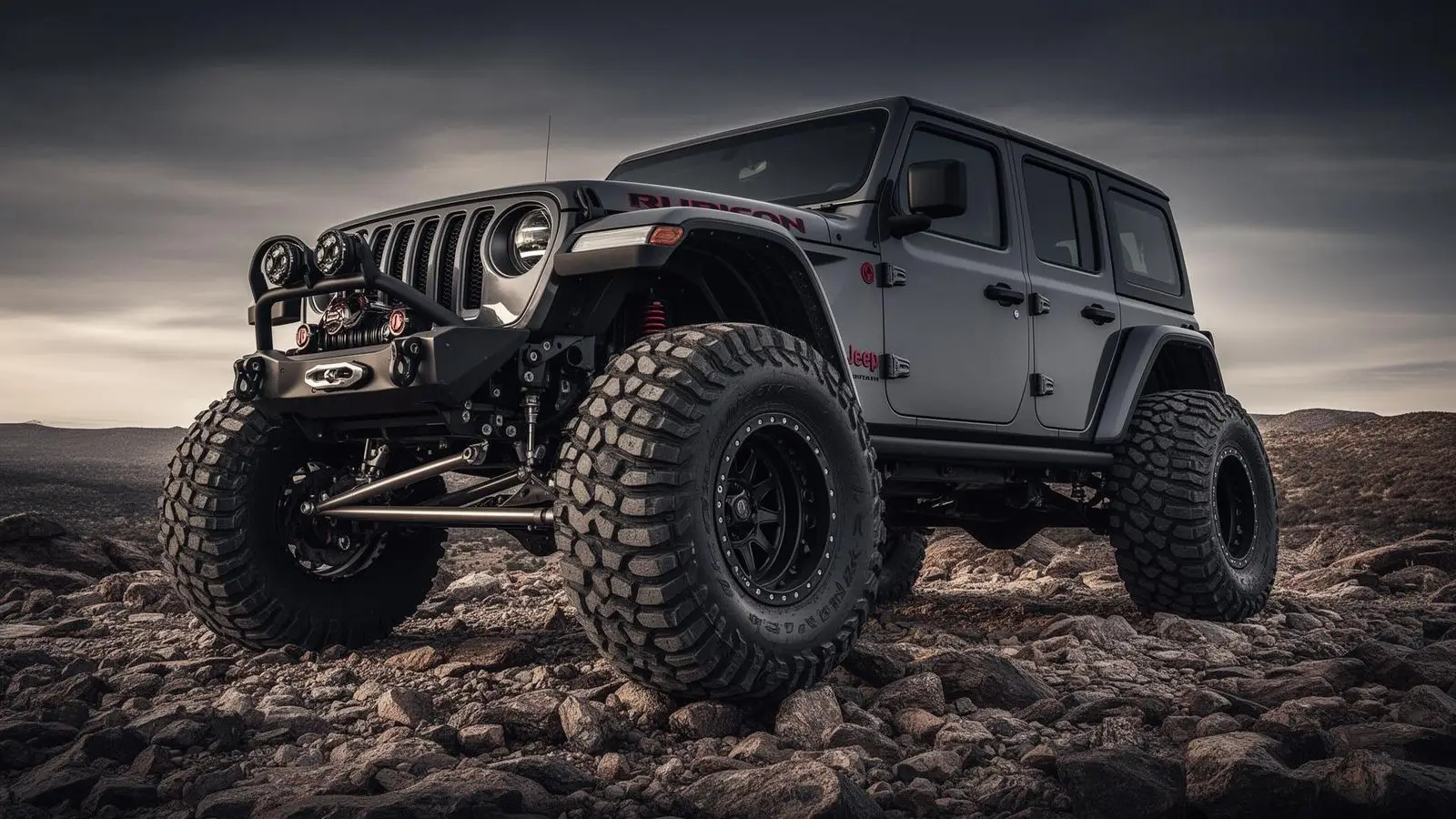
Running 40-inch tires on a JL Wrangler isn't a casual weekend project. It's a commitment to building a serious trail machine that requires significant suspension, drivetrain, and body modifications. But for those who want maximum ground clearance and the ability to tackle the most challenging terrain, 40s represent the sweet spot between capability and (somewhat) streetable.
This guide covers everything you need to know to properly run 40-inch tires on a JL Wrangler, from why long-arm suspension is essential to the full list of supporting mods that make the build work.
Why 40s Require a Different Approach
The jump from 37s to 40s isn't just three more inches of tire. It fundamentally changes what your Jeep needs to function properly. Here's why:
| Factor | 37" Tires | 40" Tires |
|---|---|---|
| Minimum Lift Required | 2.5-3.5" | 4-6" |
| Suspension Type | Short arm works | Long arm recommended |
| Gear Ratio | 4.88 typical | 5.38-5.71 required |
| Driveshaft Upgrades | Rear recommended | Front & rear required |
| Axle Upgrades | Optional | Highly recommended |
| Fender Work | Minor trimming | High-line or tube fenders |
| Approximate Weight Added | ~80 lbs per tire | ~100+ lbs per tire |
Reality Check
Why Long-Arm Suspension is Essential
At the lift heights required for 40s (4-6 inches), short-arm suspension creates significant geometry problems that make the Jeep frustrating or even dangerous to drive.
Short Arm Problems at 4"+ Lift
- Harsh ride quality, The steep control arm angle creates a choppy, bouncy ride that becomes exhausting on longer drives
- Bump steer, Steering geometry changes cause the wheel to turn unexpectedly when hitting bumps
- Wandering steering, The Jeep feels nervous and requires constant correction at highway speeds
- Reduced articulation, Despite the lift, actual wheel travel decreases due to poor geometry
- Accelerated wear, Bushings, ball joints, and tie rod ends wear significantly faster
How Long Arms Fix This
Long-arm suspension uses longer control arms mounted at new points on the frame (typically via a crossmember). This allows the arms to maintain near-stock geometry angles even at higher lift heights, resulting in:
- Significantly improved ride quality
- Stable highway tracking
- Increased articulation and wheel travel
- Proper caster and pinion angles
- Reduced wear on suspension components
Long-Arm System Options
Not all long-arm kits are created equal. Here are the main types and what they offer:
| System Type | Price Range | Best For |
|---|---|---|
| 3-Link Front / 4-Link Rear | $4,500 - $7,000 | Trail use with daily driving |
| 4-Link Front / 4-Link Rear | $6,000 - $9,000 | Serious rock crawling |
| Triangulated 4-Link | $7,000 - $12,000 | Competition/extreme builds |
Top Long-Arm Kit Brands for JL
- Rock Krawler, Known for excellent geometry and ride quality
- EVO Manufacturing, Premium quality, competition-proven designs
- Synergy Manufacturing, Great balance of price and performance
- MetalCloak, Innovative designs with excellent articulation
- Clayton Off Road, Budget-friendly long-arm options
- Teraflex, Well-engineered kits with good support
Installation Complexity
Regearing: Non-Negotiable for 40s
The JL Wrangler's stock 3.45 or 3.73 gears are already marginal for stock tires. With 40s, the effective gear ratio drops so dramatically that the Jeep becomes nearly undriveable without regearing.
| Stock Gear | With 40" Tires (Effective) | Recommended New Gear |
|---|---|---|
| 3.45 | ~2.67 (completely gutless) | 5.38 or 5.71 |
| 3.73 | ~2.89 (barely driveable) | 5.38 or 5.71 |
| 4.10 | ~3.18 (still inadequate) | 5.38 |
5.38 vs 5.71 Gears
For 40s on a JL, the debate comes down to these two ratios:
- 5.38, Better for Jeeps that see significant highway use. Slightly better fuel economy and lower RPM cruising. Works well if you're on the smaller end of 40s (39.5" actual diameter).
- 5.71, Ideal for trail-focused builds. Better power delivery off-road and when towing. Recommended for true 40" diameter tires or heavier builds with armor, winches, etc.
Regearing Cost
Driveshaft Requirements
At 4-6 inches of lift, stock driveshafts can't handle the increased angles and often vibrate, bind, or fail entirely. Both front and rear driveshafts typically need upgrading.
Rear Driveshaft
The rear is more critical due to the steeper angle. Options include:
- 1350 CV driveshaft, Standard upgrade, handles most applications ($600-$900)
- 1350 Double Cardan, Good for extreme angles ($500-$800)
- 1410 CV driveshaft, Heavy-duty option for high-power builds ($800-$1,200)
Front Driveshaft
The front driveshaft operates at steeper angles than the rear and needs attention:
- 1350 CV driveshaft, Most common upgrade ($600-$900)
- Adams Driveshaft, Tom Woods, JE Reel, Trusted brands for JL applications
Axle Considerations
The JL Rubicon's Dana 44 axles are capable, but 40-inch tires push them to their limits, especially in aggressive trail use.
Stock Dana 44 Limits
Factory axles will survive 40s for many drivers, but they become the weak point if you:
- Rock crawl aggressively
- Run heavy armor and accessories
- Have a lead foot
- Plan on running lockers with higher torque
Upgrade Options
| Upgrade Path | Price Range | Strength Gain |
|---|---|---|
| Chromoly shafts (stock housing) | $1,200 - $2,000 | 30-40% stronger |
| Dana 44 HD (Dynatrac, etc.) | $4,000 - $6,000 | 60-80% stronger |
| Dana 60 swap (front or rear) | $6,000 - $10,000+ | 100%+ stronger |
| Full Dana 60 front & rear | $12,000 - $20,000+ | "Bulletproof" |
Fender & Body Modifications
40-inch tires don't fit in stock fender wells, period. You have several options:
High-Line Fender Conversion
This involves cutting the factory inner fender and installing high-clearance fender flares. Many kits are bolt-on and maintain a relatively stock appearance while providing the necessary clearance.
- MCE Fenders, Popular, maintains OE look ($1,200-$1,800)
- Nemesis Industries, Aggressive styling ($1,500-$2,500)
- Poison Spyder, Classic tube fender look ($800-$1,400)
Tube Fenders
For maximum clearance, tube fenders (or no fenders) are the go-to. They remove all potential contact points but change the Jeep's appearance significantly.
Brake Upgrades
Larger, heavier tires require more braking force. The stock JL brakes are adequate for casual driving, but enthusiasts often upgrade for:
- Larger rotors, Better heat dissipation
- Performance pads, Improved bite and fade resistance
- Big brake kits, For those who tow or drive aggressively ($1,500-$3,000)
40-Inch Tire Options
Tire selection at 40 inches is more limited than smaller sizes, but quality options exist:
| Tire | Size | Type | Weight |
|---|---|---|---|
| Nitto Trail Grappler | 40x13.50R17 | Hybrid M/T | ~95 lbs |
| BFG KM3 | 40x13.50R17 | Mud Terrain | ~97 lbs |
| Toyo MT | 40x15.50R22 | Mud Terrain | ~106 lbs |
| Mickey Thompson Baja Boss | 40x13.50R17 | Mud Terrain | ~91 lbs |
Complete Build Cost Breakdown
| Component | Budget | Mid-Range | Premium |
|---|---|---|---|
| Long-Arm Suspension | $4,500 | $7,000 | $12,000 |
| Shocks (Set of 4) | $800 | $2,000 | $4,000+ |
| Tires (Set of 5) | $2,500 | $3,500 | $4,500 |
| Wheels (Set of 5) | $1,000 | $1,800 | $3,000 |
| Regearing (Both Axles) | $2,500 | $3,000 | $3,500 |
| Driveshafts (F&R) | $1,200 | $1,800 | $2,500 |
| Fenders/Body Work | $800 | $1,500 | $2,500 |
| Installation Labor | $2,000 | $3,500 | $5,000 |
| Total | ~$15,300 | ~$24,100 | ~$37,000+ |
Hidden Costs
Daily Driving Reality
Can you daily drive a Jeep on 40s? Technically yes, but with significant trade-offs:
- Fuel economy: Expect 10-12 mpg combined
- Parking: Significantly wider and taller than stock
- Ride quality: Harsher even with long arms (tire sidewall stiffness)
- Noise: Most 40s are aggressive tread patterns
- Wear items: Brakes, steering components, and bushings wear faster
The Verdict
Running 40-inch tires on a JL Wrangler is a serious commitment that transforms the vehicle into a dedicated trail machine. It's not a casual upgrade, it's a build project that requires significant investment in time, money, and supporting modifications.
Bottom Line
- Long-arm suspension is essential, not optional
- Regearing to 5.38 or 5.71 is mandatory
- Budget $15,000-$30,000+ for a complete, reliable build
- Expect significant daily driving compromises
- The capability gains are massive for serious trail use
For those who need maximum ground clearance and aren't afraid of the commitment, 40s on a properly built JL represent one of the most capable factory-based trail rigs you can create. Just go in with eyes open about what it takes to get there.