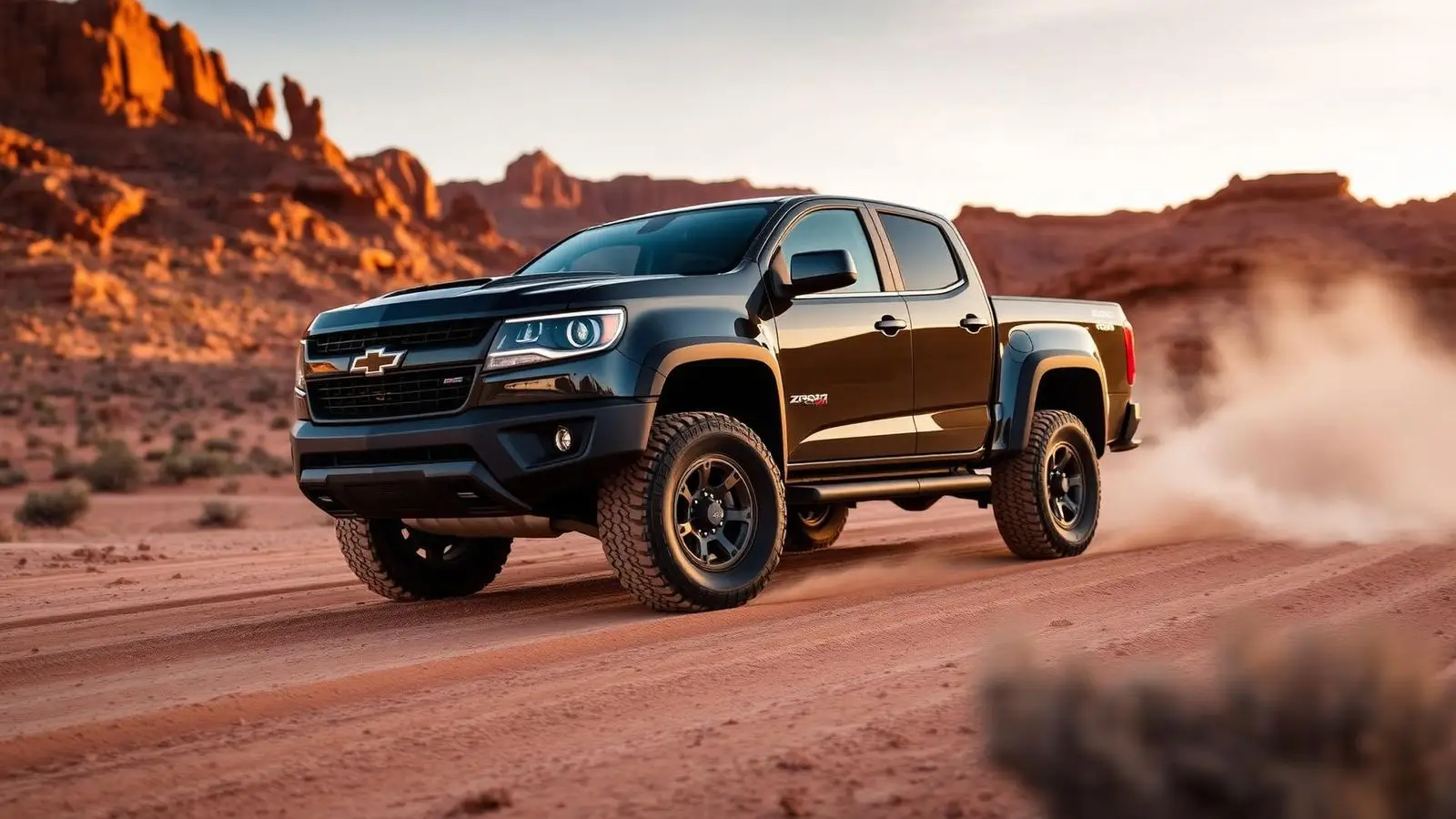
The mid-size truck overlanding conversation has been dominated by Toyota for so long that most buyers treat it as settled. Tacoma Trailhunter if you want the factory overlanding package. Gladiator Rubicon if you want maximum crawling credibility. Everything else if you're willing to compromise. That framing is costing buyers real money and real capability.
Quick Answer
The 2026 Colorado ZR2 offers the highest approach angle in the mid-size IFS class (38.2°), dual locking differentials that the $63,000 Tacoma Trailhunter doesn't have, and Multimatic DSSV dampers, all for around $50,000. It's the most underrated mid-size overlanding truck on the market.
What's New for 2026
The 2026 Colorado ZR2 is a refinement year, not a redesign. The powertrain, suspension, and off-road electronics carry over unchanged from the third-generation platform introduced in 2023. New for 2026: two fresh exterior colors including Magnus Gray Matte Metallic, a new Desert Boss package targeting high-speed desert running, and minor interior updates including wireless Apple CarPlay and Android Auto now standard across the lineup.
The core ZR2 hardware, the hardware that matters for trail use, is identical to the 2025 model. If you're comparing the 2025 and 2026 ZR2 for overlanding purposes, the decision comes down to color and price, not capability.
The Numbers That Define This Truck
The Colorado ZR2's most impressive spec is one that gets almost no coverage: a 38.2-degree approach angle on 33-inch Goodyear Wrangler Territory MT tires. For context, the Toyota Tacoma Trailhunter has a 35.2-degree approach angle. The Jeep Gladiator Rubicon sits at 43.9 degrees with its disconnecting sway bar and solid front axle. The ZR2 at 38.2 degrees lands between them, and it does it with an independent front suspension setup.
Ground clearance on the standard ZR2 is 10.7 inches, slightly lower than the Tacoma Trailhunter's 11.0 inches, but the approach geometry more than compensates for most real-world obstacles. The ZR2 Bison package pushes clearance to 12.2 inches with 35-inch tires and AEV armor.
The departure angle at 25.1 degrees and breakover at 26.9 degrees round out a trail geometry package that is genuinely impressive for a production mid-size truck without a solid front axle.
The Dual Locker Advantage
This is the specification that should be driving more conversation than it does. The ZR2 comes standard with Eaton electronic locking differentials front and rear. Both can be engaged independently or together, with the front locker only available after the rear is engaged. In 4-Low below 25 mph, you can run both locked simultaneously.
Dual Locker Comparison
- Colorado ZR2: Front + rear electronic lockers (standard)
- Gladiator Rubicon: Front + rear Dana 44 lockers (standard)
- Tacoma Trailhunter: Rear locker only, no front locker
- Ranger Raptor: Rear locker only
- Ram 1500 RHO: Rear locker only
In technical rock crawling, in deep mud where one axle is fully unloaded, a locked front differential is the difference between moving and winching. The ZR2 has one. Most of its competition does not.
Multimatic DSSV Shocks: What They Actually Do
The Multimatic Dynamic Spool-Valve dampers replace conventional fixed shim stacks with a laser-cut spool valve system. The spool valve has position-sensitive windows that open and close as the damper travels through its stroke. Early in the stroke, you get soft, compliant response for small bumps. Deep in the stroke, the damper stiffens dramatically to prevent bottoming.
The result is a shock that feels soft on washboard, firms up when you land a drop, and transitions continuously without the ping-pong effect of electronically controlled adaptive systems. It's also position-sensitive, not velocity-sensitive, the response curve is predictable and repeatable.
DSSV vs OME
For high-speed desert running, the DSSV system is exceptional. For slow technical rock crawling where you want maximum compliance at very low speeds, the OME shocks on the Trailhunter arguably give you a more deliberate, driver-controlled character. It's a real difference in character, not a quality difference.
Suspension travel is 9.9 inches up front and 11.6 inches in the rear, competitive in the class and supportive of the ZR2's high-speed capability.
Powertrain for the Trail
The ZR2 runs a 2.7-liter TurboMax turbocharged inline-four producing 310 horsepower and 430 lb-ft of torque through an 8-speed automatic. Turbo torque arrives early and broad, suiting trail use well. Low-speed obstacle approaches, sand momentum sections, and loaded climbs all benefit from the engine's willingness to pull from the bottom of the rev range.
The Tacoma Trailhunter's i-Force MAX hybrid makes 326 hp and 465 lb-ft, it outpowers the ZR2 meaningfully on torque. In real-world trail use, the difference shows in high-demand situations like steep climbs fully loaded. The ZR2 isn't slow or underpowered; it's outgunned by a more sophisticated and more expensive drivetrain.
Towing is rated at 6,000 pounds. Real-world fuel economy lands around 15-17 mpg combined, with 14-15 mpg on trail days and 18-19 mpg on highway runs.
Off-Road Mid-Size Truck Comparison
2026 Mid-Size Off-Road Truck Specs
Head-to-head comparison of the top mid-size off-road trucks for overlanding.
| Spec | Colorado ZR2 | Tacoma Trailhunter | Gladiator Rubicon | Ranger Raptor |
|---|---|---|---|---|
| Starting MSRP | ~$50,000 | ~$63,000 | ~$43,545 | ~$56,070 |
| Engine | 2.7L Turbo I4 | 2.4L Hybrid I4 | 3.6L V6 | 2.7L TT EcoBoost |
| Horsepower | 310 hp | 326 hp | 285 hp | 405 hp |
| Torque | 430 lb-ft | 465 lb-ft | 260 lb-ft | 430 lb-ft |
| Ground Clearance | 10.7" | 11.0" | 11.8" | 13.0" |
| Approach Angle | 38.2° | 35.2° | 43.9° | 32.5° |
| Departure Angle | 25.1° | 22.3° | 37.0° | 26.3° |
| Front Locker | ||||
| Rear Locker | ||||
| Factory Tires | 33" Goodyear MT | 33" Goodyear R/T | 33" MT | 33" BFG KO2 |
| Shocks | Multimatic DSSV | OME w/ reservoirs | Bilstein | Fox |
| Towing | 6,000 lbs | 6,000 lbs | 7,650 lbs | 7,500 lbs |
| Payload | ~1,350 lbs | 1,475 lbs | ~1,200 lbs | ~1,820 lbs |
The Gladiator Rubicon remains king of approach and departure geometry. The Ranger Raptor leads on ground clearance and payload. The Trailhunter leads on torque with brand reputation. The ZR2 leads on approach angle among IFS trucks and is the only non-Gladiator with a locking front differential, while costing $13,000 less than the Trailhunter.
Skid Plate Coverage: Get This Right Before You Trail
The standard ZR2 has underbody skid plate coverage, but it's not comprehensive from the factory. The ZR2 Bison package takes protection seriously: five boron steel skid plates from AEV cover the front, engine, transfer case, fuel tank, and rear differential.
Standard ZR2 Skid Plates
On a standard ZR2, plan to add aftermarket skid plate coverage before sustained rocky trail use. Brands including Addictive Desert Designs and AEV sell bolt-on protection kits. Budget $600, $1,200 for meaningful coverage.
2026 Colorado ZR2 Reliability
Early third-generation Colorado ZR2 units from 2023 have a documented pattern of issues: software glitches serious enough that GM temporarily halted sales, intermittent engine shutdown reports, turbocharger failures in a small number of units, and interior quality complaints. 2024 and 2025 production units show meaningfully improved software calibration and reduced complaint frequency.
Honest Assessment
The ZR2 does not have the long-duration reliability track record that a Tacoma carries into its fifth or sixth year of overlanding service. Buy a 2024 or newer unit, get an extended warranty for remote use, and build your first year of ownership close enough to civilization that an unscheduled shop visit is an inconvenience rather than a stranding.
Five Drive Modes for Overlanders
- Normal: Everything on pavement and maintained dirt
- Off-Road: Tightened calibration for variable traction, adjusts throttle response and traction control for loose surfaces and forest service roads
- Terrain: Slow-speed technical mode, engages 4-Low, allows locker activation, manages throttle and braking for obstacle crawling
- Baja: ZR2-exclusive, loosens every tether on the truck for maximum power and high-speed dirt. Reveals what the DSSV dampers were engineered for
- Tow/Haul: Adjusts shift points and cooling priority for loaded towing
Who Should Buy the 2026 Colorado ZR2
Best For
- Overlanders who value off-road geometry and electronic capability over brand reputation
- Buyers where $13,000 savings over the Trailhunter matters to their budget
- Those comfortable with a newer, less community-tested platform
- High-speed desert runners who want the DSSV advantage
- Anyone who needs dual lockers in a mid-size truck without Gladiator bulk
The ZR2 Bison is the version for buyers who want the full package from the factory: five AEV boron steel skid plates, 35-inch tires, and 12.2 inches of clearance. It adds approximately $6,000 and eliminates most aftermarket investment needed to make a standard ZR2 trail-ready.
Who Should Look Elsewhere
- Toyota reliability is non-negotiable: The Tacoma Trailhunter's multi-generation track record earns its premium
- Maximum payload needed: The ZR2's ~1,350-lb payload fills up faster than the Trailhunter's 1,475 or Ranger Raptor's 1,820
- Technical rock crawling is primary use: The Gladiator Rubicon's solid front axle with sway bar disconnect provides articulation the ZR2's IFS cannot match
Bottom Line
Our Verdict
The 2026 Chevy Colorado ZR2 is the most underrated mid-size overlanding truck on the market. With the best approach angle among IFS trucks, dual lockers that most competitors lack, and Multimatic DSSV technology, all at $13,000 less than the Tacoma Trailhunter, it deserves a place at the top of every serious overlander's shopping list. The reliability question is real, but the capability and value proposition are impossible to ignore.