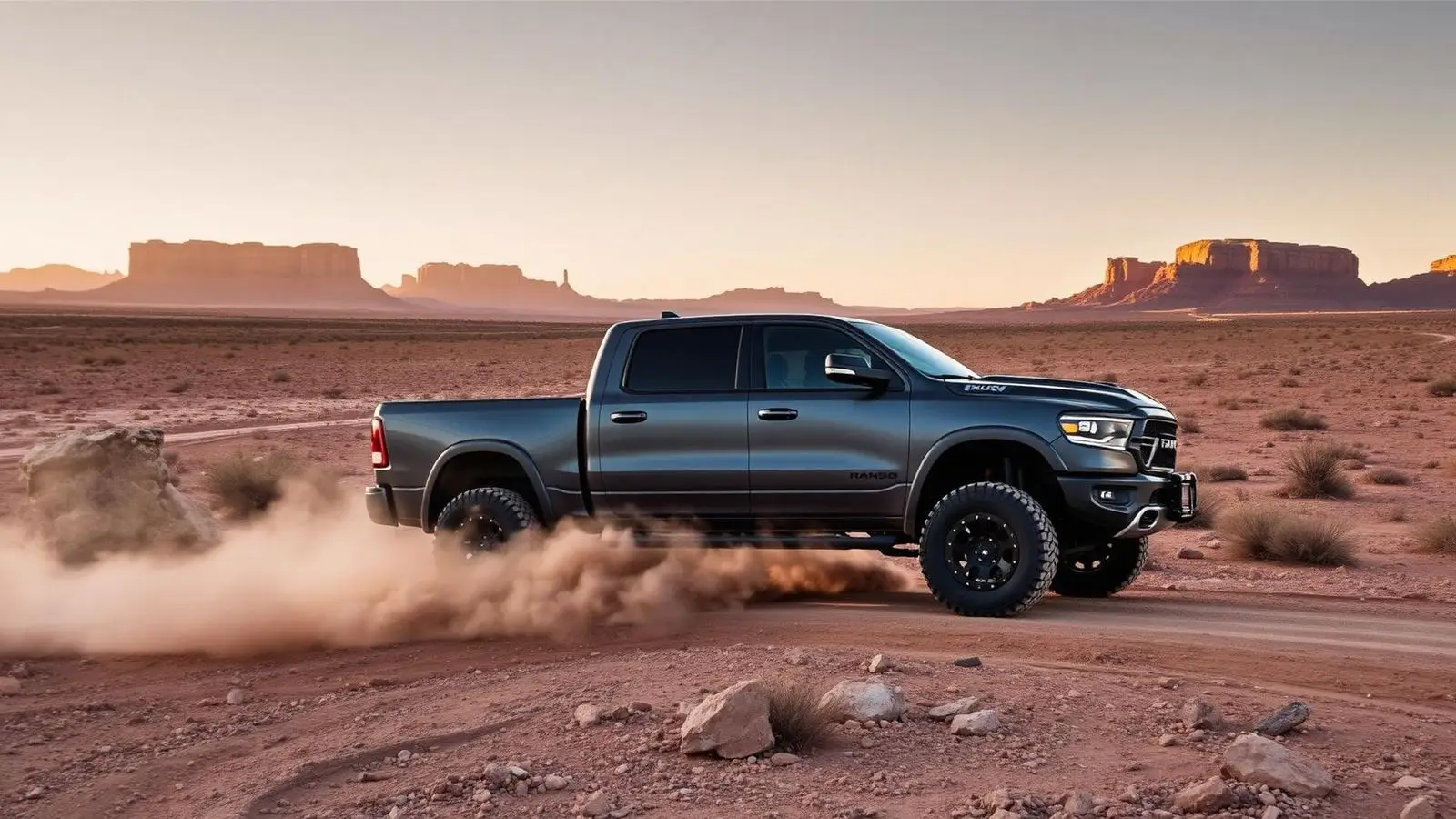
Pull into any overlanding meetup and take a headcount. Tacomas, 4Runners, Wranglers, Broncos, and at least three F-150 Raptors with identical Prinsu racks. What you won't find is a Ram 1500 RHO. That's not because it's worse, by several of the numbers that actually matter, it's better.
Quick Take
What the RHO Actually Is
First, a clarification the automotive press has been sloppy about: the Ram 1500 RHO is not a supercharged truck. It runs a 3.0-liter High-Output twin-turbocharged Hurricane inline-six engine producing 540 horsepower and 521 lb-ft of torque through an 8-speed automatic transmission.
The twin-turbo setup matters for overlanding in ways the power numbers alone don't convey. Turbo torque arrives low in the rev range and stays broad, smooth, controlled power delivery on trail sections where finesse matters more than peak output. Diesel-like low-end pull without the diesel price premium, maintenance overhead, or fuel-finding anxiety in remote areas.
Real-world fuel economy lands around 15 mpg combined. Highway runs have owners reporting close to 20 mpg on 500-mile stretches. Towing a 7,000-pound trailer drops it to approximately 8 mpg. Not exceptional for the class, but not dramatically worse than the Raptor's equivalent figures.
Off-Road Specs: The Numbers and What They Mean
RHO vs Raptor: Trail Geometry
Head-to-head off-road specifications comparison
| Spec | Ram 1500 RHO | F-150 Raptor (35") | F-150 Raptor (37") |
|---|---|---|---|
| Ground Clearance | 11.8" | 12.0" | 13.1" |
| Approach Angle | 31° | 31° | 33.1° |
| Departure Angle | 25° | 24.9° | 24.9° |
| Breakover Angle | 22° | 24.4° | 24.4° |
| Front Suspension Travel | 13" | 14" | 14" |
| Rear Suspension Travel | 14" | 15" | 15" |
| Factory Tires | 35" Goodyear Territory A/T | 35" BFG KO2 | 37" BFG KO2 |
| Shocks | Bilstein Black Hawk e2 | Fox Live Valve | Fox Live Valve |
| Rear Locker | Electronic (Dana 60) | Electronic | Electronic |
| Starting MSRP | ~$69,995 | ~$78,330 | Additional cost |
Against the standard 35-inch Raptor, the RHO is within rounding error on every trail geometry number. The Raptor pulls meaningfully ahead only when optioned with 37-inch tires, which push clearance to 13.1 inches and approach angle to 33.1 degrees.
Where the Raptor has a genuine advantage: suspension travel. Fox Live Valve shocks with 14 inches of front travel and 15 inches of rear versus the RHO's 13 and 14. For high-speed desert running and Baja-style abuse, that extra travel is real. For overlanding at controlled trail speeds, the Bilstein Black Hawk e2 adaptive shocks are more than capable.
Nine Drive Modes: What They Do for Overlanders
The RHO's nine drive modes, Auto, Custom, Tow, Sport, Snow, Baja, Rock, Mud/Sand, and Valet, cover more scenarios than the Raptor's lineup and include a level of specificity that's genuinely useful on trail.
Rock Mode
Firms throttle mapping for precise low-speed control, tightens traction control calibration to allow deliberate wheelspin for obstacle clearance, and keeps the rear locker engaged. For shelf roads, rock gardens, and slow technical obstacles, this is where the truck earns its keep.
Mud/Sand Mode
Increases wheelspin tolerance significantly. The truck allows the tires to spin up and find traction rather than cutting power. In deep sand, this is the difference between momentum and high-centering.
Baja Mode
Shifts the transfer case to 4-HI and optimizes power distribution for high-speed off-road running. Full power, maximum articulation, aggressive torque split. Not for family campsite runs, for when the trail opens up and you want to feel 540 horsepower in 4WD.
Custom Mode
Mix and match: suspension setting from one mode, throttle mapping from another, traction control from a third. For experienced drivers who know their terrain, this is the one to dial in for a specific trip.
The Honest Overlanding Limitations
Know Before You Buy
The Front Differential Situation
The RHO has an electronically locking rear differential on a full-float Dana 60 rear axle, a strong rear end. What it doesn't have is a front locker. IFS trucks don't get front lockers from the factory. For sustained technical rock crawling where a front locker is the difference between moving and winching, the RHO reaches its ceiling. But this is a fact about every IFS half-ton truck on the market, including the Raptor.
The Skid Plate Gap
The RHO comes with front underbody skid plate coverage as standard. Extended coverage for the engine, transfer case, and rear differential is available through the aftermarket. Addictive Desert Designs, Ram's Direct Connection accessories line, and several specialists have bolt-on kits. Budget $600, $1,200 for comprehensive coverage and install it before the first serious trail run.
Early-Production Electrical Issues
The 2025 Ram 1500 RHO has a documented pattern of electrical gremlins in early-production units: battery drain from the Body Control Module, intermittent front axle disconnect malfunctions, and misfire codes within the first few hundred miles. Ram has issued Technical Service Bulletin (08-380-25) addressing the BCM reflash. If buying a 2025 or early unit, confirm the software update has been applied.
The Aftermarket Gap
The F-150 Raptor has fifteen-plus years of aftermarket development. Roof rack fitment, sleeping platform kits, skid plate systems, bumper replacements, a mature ecosystem that doesn't yet exist at the same scale for the RHO. Ram launched its Direct Connection accessories line, and brands are adding RHO-specific products. But the RHO is two to three years behind. That gap is closing, it's not gone yet.
The Loaded Overlanding Math
If you tow a trailer, off-road teardrop, utility trailer for an ATV, or a boat, the RHO's 8,380-pound tow rating and 1,520-pound payload give you meaningful headroom above the Raptor's 8,300-pound tow and 1,400-pound payload.
The 120-pound payload difference sounds small. In practice, two adults plus a full overlanding kit in the bed can push payload limits faster than buyers expect. The RHO gives you more margin before you're overloaded.
At $69,995 base versus $78,330 for the standard Raptor, that $8,000+ difference buys comprehensive skid plate coverage, an aftermarket bumper upgrade, or a serious supply of trail consumables.
RHO vs F-150 Raptor: The Bottom Line
Full Comparison: RHO vs Raptor vs Raptor R
| Spec | Ram 1500 RHO | F-150 Raptor (35") | F-150 Raptor R |
|---|---|---|---|
| Engine | 3.0L Twin-Turbo I6 | 3.5L Twin-Turbo V6 | 5.2L Supercharged V8 |
| Horsepower | 540 hp | 450 hp | 720 hp |
| Torque | 521 lb-ft | 510 lb-ft | 640 lb-ft |
| Ground Clearance | 11.8" | 12.0" | 13.1" |
| Tow Rating | 8,380 lbs | 8,300 lbs | 8,700 lbs |
| Payload | 1,520 lbs | 1,400 lbs | ~1,200 lbs |
| Shocks | Bilstein e2 Adaptive | Fox Live Valve | Fox Live Valve |
| Factory Tires | 35" | 35" | 37" |
| Drive Modes | 9 | 7 | 7 |
| Starting MSRP | ~$69,995 | ~$78,330 | ~$110,365 |
| Power per Dollar | Best in class | Middle | Worst value |
| Aftermarket Depth | Growing | Mature | Mature |
Who Should Buy the Ram 1500 RHO
The RHO is the right truck if you prioritize capability and value over community identity. If you tow a trailer and need payload headroom. If you run your truck loaded and want 90 more horsepower than the standard Raptor for $8,000 less. If you're comfortable being the person at the trailhead who drives a truck most people underestimate.
- Buy certified or with a clear service record to avoid early-production electrical issues
- Add full skid plate coverage before your first rocky trail
- Give the aftermarket ecosystem another 18 months and the catalog gap will largely close
Who Should Look Elsewhere
If you're buying partly for the community, the decals, the forum membership, the nod at the trailhead, the Raptor delivers that and the RHO doesn't yet.
If you plan to run extended high-speed desert terrain, the Fox Live Valve system's extra inch of travel per end and proven high-velocity damping are meaningful advantages.
If long-term reliability certainty over 150,000 hard miles is your primary criterion, the EcoBoost Raptor has a longer and more documented track record than the Hurricane I6. The RHO will likely match it, the data proving that doesn't exist yet.
The Bottom Line
The Ram 1500 RHO is not a compromise vehicle. It's a different set of priorities, and for the overlander who cares about what a truck does more than what it represents, it may be the best performance half-ton you can buy in 2026.