The Manufacturing Divide
When shopping for alloy wheels, you'll encounter two main manufacturing methods: cast and forged. Understanding how each is made reveals why they perform so differently on the trail and on the street.
Cast Alloy Wheels: The Common Choice
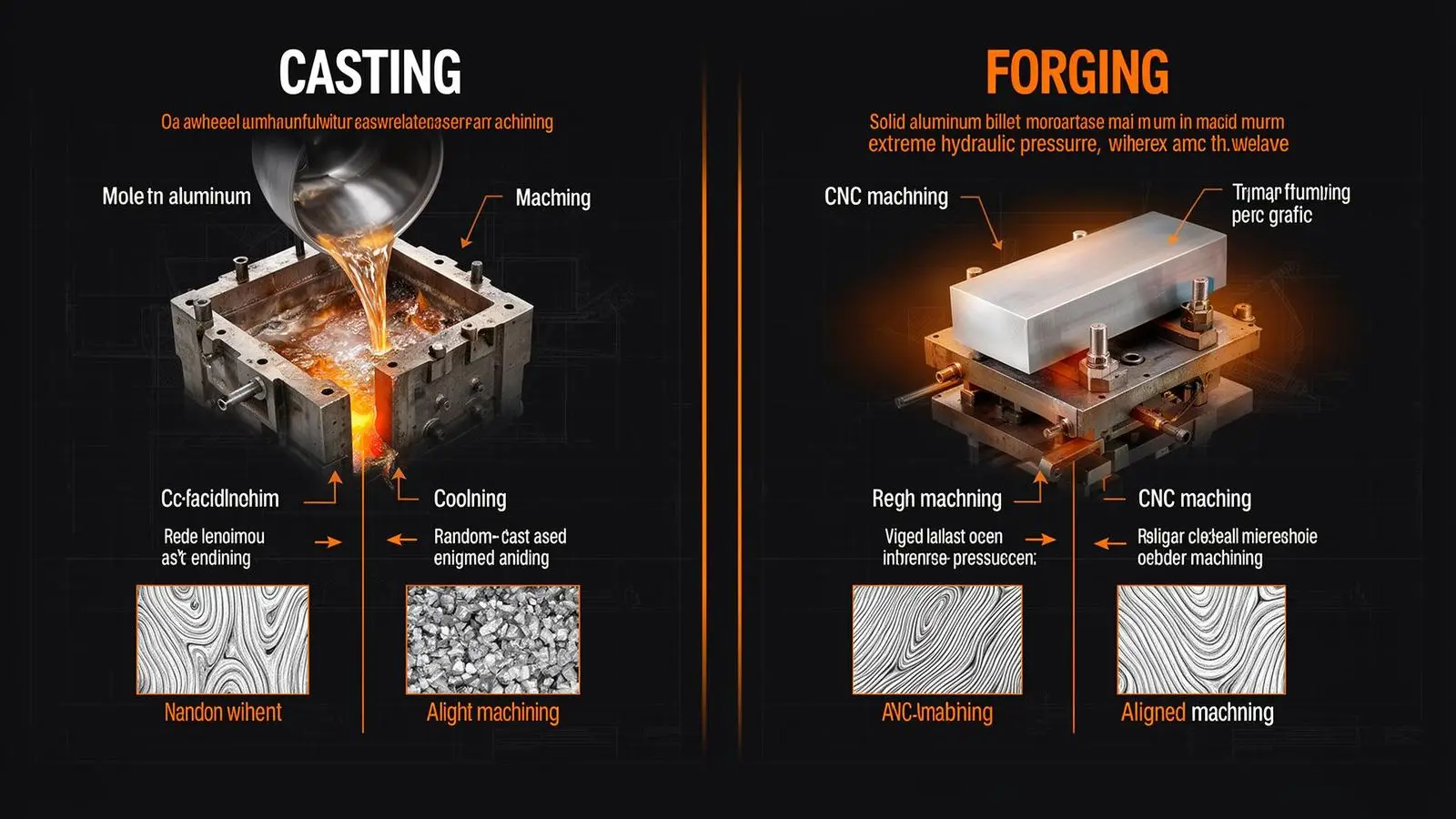
Cast wheels are manufactured by pouring molten aluminum alloy into a mold. Once cooled, the wheel is machined to final dimensions. This process is cost-effective and allows for complex designs, making cast wheels the most common type on the market.
Casting Methods
- Gravity casting: Molten metal flows into the mold via gravity. Most affordable but least dense structure.
- Low-pressure casting: Uses pressure to force metal into the mold, creating denser, stronger wheels.
- Flow forming (rotary forged): A hybrid process where a cast wheel barrel is stretched and compressed while spinning, approaching forged-level strength in the barrel.
Advantages of Cast Wheels
- Cost: Significantly more affordable than forged options
- Variety: Vast array of designs and finishes available
- Availability: Easier to find in most sizes and bolt patterns
- Good enough: Quality cast wheels handle most driving scenarios well
Disadvantages of Cast Wheels
- Weight: 20-30% heavier than equivalent forged wheels
- Strength: More prone to cracking under severe impact
- Porosity: Microscopic air pockets can weaken structure
- Repairability: Cracked wheels typically need replacement
Forged Alloy Wheels: The Premium Choice
Forged wheels start as a solid billet of aluminum that's heated and pressed under extreme pressure (up to 10,000 tons). This process aligns the metal's grain structure, creating a significantly stronger and lighter wheel.
Forging Types
- One-piece forged: Machined from a single billet. Maximum strength and lightest weight possible.
- Two-piece forged: Separate center and barrel bolted together. Allows different finishes and easier customization.
- Three-piece forged: Center plus inner and outer barrel sections. Ultimate customization but most complex.
Advantages of Forged Wheels
- Strength: 3-4 times stronger than cast due to aligned grain structure
- Weight: 20-30% lighter than equivalent cast wheels
- Durability: Bends on impact rather than cracking
- Repairability: Damaged forged wheels can often be straightened
- Density: No porosity issues; consistent material throughout
Disadvantages of Forged Wheels
- Cost: 2-5x more expensive than quality cast wheels
- Lead time: Often requires longer wait for custom orders
- Selection: Fewer design options available
Weight Comparison
For a typical 17x9 wheel:
- Gravity cast alloy: 28-32 lbs
- Low-pressure cast alloy: 26-30 lbs
- Flow-formed alloy: 22-26 lbs
- Forged alloy: 18-22 lbs
That's potentially 40+ lbs saved across all four corners with forged versus gravity cast – a significant reduction in unsprung weight that improves ride, handling, braking, and acceleration.
Strength Under Impact
Trail Impacts
Cast wheels tend to crack when hitting rocks at speed. Forged wheels are more likely to bend, which can often be repaired. For serious rock crawling or high-speed desert running, forged wheels provide crucial durability advantages.
Daily Driving
For pothole encounters and curb impacts, quality cast wheels (especially flow-formed) perform adequately. Only budget cast wheels show significant weakness compared to forged options.
Competition Use
Racing and competition demand forged wheels. The combination of light weight for better suspension response and superior impact resistance makes them the only serious choice for hard use.
Cost Breakdown
- Gravity cast: $150-$300 per wheel
- Low-pressure cast: $200-$400 per wheel
- Flow-formed: $300-$600 per wheel
- One-piece forged: $500-$1,500 per wheel
- Multi-piece forged: $800-$2,500+ per wheel
Flow-Formed: The Middle Ground
Flow-forming (also called rotary forging or spun rim) deserves special mention. The barrel section achieves near-forged strength while the center remains cast. This hybrid approach delivers:
- Weight savings approaching forged (15-20% lighter than cast)
- Improved barrel strength for tire mounting
- Cost between cast and forged
- More style options than full forged
Which Should You Choose?
Choose Cast Wheels If:
- Budget is your primary concern
- You want a specific style only available in cast
- The vehicle is primarily a daily driver or show truck
- You're not doing serious off-road driving
Choose Flow-Formed If:
- You want the best balance of performance and value
- Weight reduction matters but budget is limited
- You do moderate off-roading and daily driving
- Near-forged strength appeals without the price tag
Choose Forged Wheels If:
- You're serious about off-road performance
- Weight reduction is a top priority
- You need maximum durability for rock crawling or racing
- Long-term value outweighs upfront cost
- You want wheels that can be repaired if damaged
Top Brands by Category
Best Cast Wheel Brands
- Fuel Off-Road: Aggressive styling, solid quality
- Moto Metal: Good value and selection
- XD Series: Truck-focused designs
- Hostile: Bold off-road looks
Best Flow-Formed Brands
- Method Race Wheels: Premium off-road focus
- Icon Alloys: Quality at fair prices
- Rotiform: Street and off-road options
- Enkei: Racing heritage
Best Forged Brands
- American Force: True forged off-road wheels
- RBP: Forged options for trucks
- Weld Racing: Motorsport-proven
- Fittipaldi: Luxury forged options
The Bottom Line
For most truck and Jeep builds, quality flow-formed wheels offer the best balance of performance and value. They provide significant weight savings and improved strength without the substantial price premium of fully forged wheels. Reserve true forged wheels for dedicated competition vehicles or builds where maximum performance justifies the investment. And don't overlook quality cast wheels for daily drivers and light off-road use – they've served enthusiasts well for decades.